How Bowling Centers Use Digital Signage to Fill Off-Peak Lanes and Earn From Concourse Screens
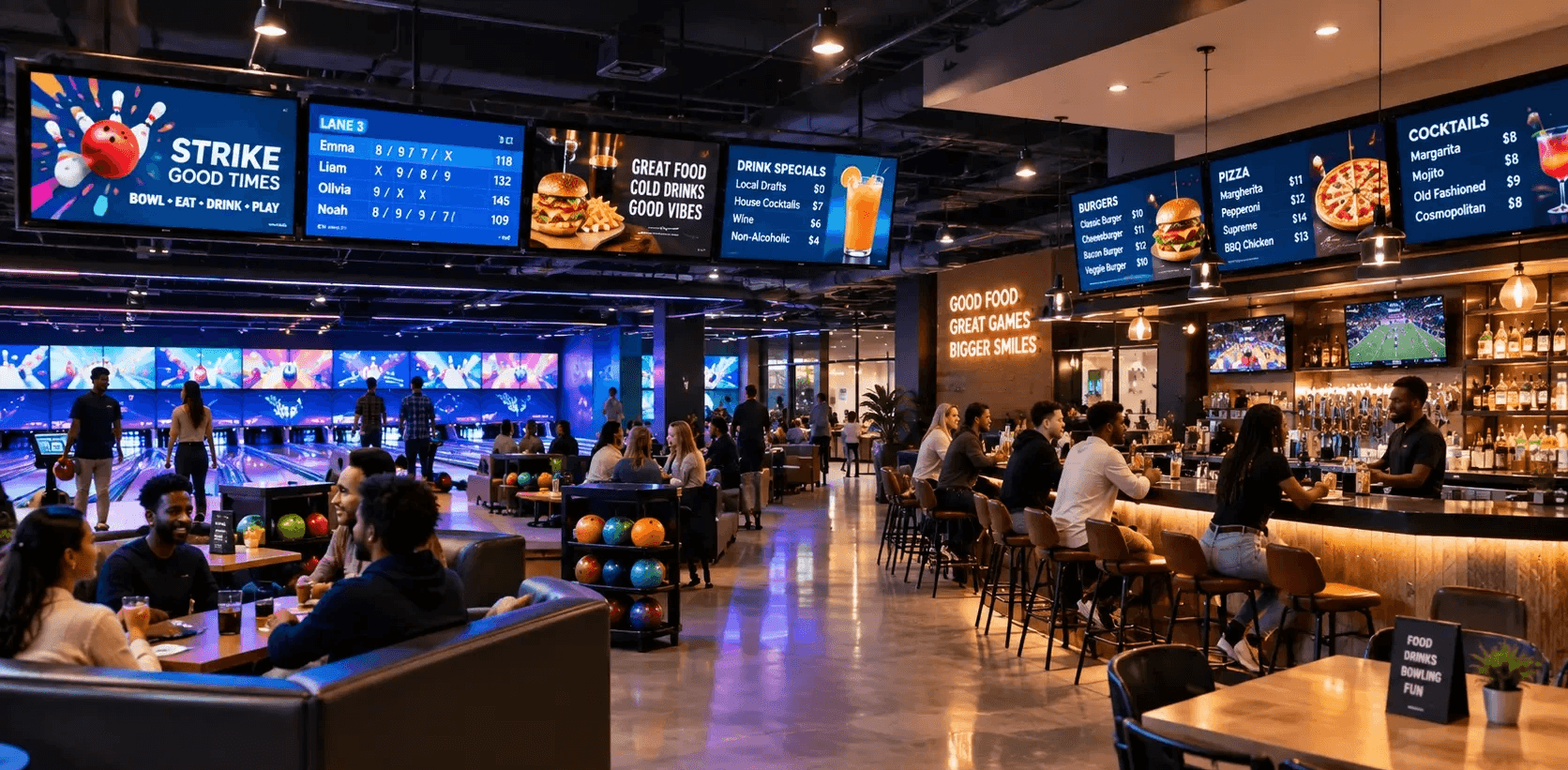
Bowling centers already own the screens they need to move two numbers that matter: lane utilization on slow weekday shifts and per-head food and beverage spend. The screens above your lanes, behind your bar, and at the shoe counter run scoring graphics and little else for most of the day, which means they carry no message and earn no money. Meanwhile, US out-of-home advertising revenue reached a record $9.46 billion in 2025, and digital out-of-home grew 10.5% to take 36.3% of that total (OAAA). Advertisers are paying for attention in real venues. Your concourse is one.
The two problems bowling centers actually have
The first is capacity that expires. A lane empty at 2 pm Tuesday is revenue you can never recover. There are 2,597 bowling centers in the United States, and the count has fallen by roughly 1.9% a year since 2020, so the operators still standing are the ones who learned to sell weekday afternoons, corporate events, and birthday blocks rather than wait for Friday leagues to carry the week (IBISWorld).
The second is per-capita. Modernized centers that lean into the family entertainment center model report up to 40% higher per-capita spend than traditional alleys, mostly through food, beverage, and ancillary attractions (Mordor Intelligence). That lift comes from guests knowing what is available and ordering it, which is a communication problem before it is a menu problem.
A lane empty at 2 pm Tuesday is revenue you can never recover.
What to put on the screens
Treat each screen zone as a job, not decoration.
Lane-end and overhead screens: lane-side ordering prompts, current pitcher and appetizer specials, and the next open block for walk-ins.
Concourse and walkway screens: party package tiers, league sign-up windows, corporate event pricing, and gift card offers.
Bar and dining screens: game day schedules, happy hour windows, and limited-time food items with prices shown clearly.
Front counter and shoe desk: wait time, current lane availability, and membership or unlimited-play pass pricing.
Two rules keep this honest. Show price on anything you want people to order, because a promotion without a number gets ignored. And rotate weekday content separately from weekend content, since the 2 pm guest and the 9 pm guest want different things.
Key stat box. US out-of-home revenue hit a first-quarter record of $2.12 billion in Q1 2026, with digital out-of-home up 12.9% year over year. The share of ad budgets flowing to screens in real places is still climbing.
Be honest about what signage can and cannot prove
Signage and DOOH attribution is directional. You can see that per-cap rose in the weeks after you put priced specials on the lane-end screens, and that is useful, but you cannot isolate the screen from staffing, weather, school calendars, or the new seasonal menu. Attention research on place-based formats is also mixed: one US study found 21% of respondents look at digital place-based ads all the time, which means the majority do not, so treat each screen as one nudge among several rather than a guaranteed conversion (Statista). Signage does not change your Google rankings either. It can prompt branded searches and reviews, which are different things.
Measure it the way you measure anything else in the building. Pick one KPI, change one thing, and compare like shifts. Weekday lane utilization by daypart and food and beverage per guest are the two worth tracking first.
How Beam helps
Beam does two things for a bowling center, and the second is the one most signage platforms cannot offer.
First, it manages your screens. You schedule party packages, league windows, and daypart specials from one place, set weekday and weekend playlists, and push a change to every screen in the building without walking the concourse with a USB stick.
Second, Beam opens your idle screen time to the Beam Network, its approved third-party advertiser marketplace. Your promotions keep priority. The gaps that would otherwise show a static logo get filled with vetted advertising you approve, and those impressions pay you. Beam handles the demand side, so you never have to sell an ad yourself.
How Beam helps, in one line. Your own promotions run first. Beam fills the leftover screen time with approved advertisers and pays you for it.
Earnings depend on your traffic, screen count, and market, so treat any figure you see as a range rather than a promise.
Start with one daypart
Pick your slowest weekday shift. Put one priced offer and one party package on the lane-end and concourse screens for four weeks. Compare lane utilization and per-guest food and beverage spend against the same shift the month before. If it moves, expand the schedule. If it does not, change the offer before you change the technology.
See what your screens could earn and how fast you can get content live at usebeam.io
Sources
Can I use the TVs I already have?
In most cases, yes. Commercial-grade displays last longer under long daily run times, but a consumer TV with an HDMI input and reliable power will run signage. The media player and software matter more than the panel.
Will ads on my screens annoy my guests?
They can if the mix is wrong. Keep your own promotions dominant, cap ad frequency, and approve the advertiser categories that fit a family and adult entertainment venue. Guests in a bowling center already expect branded content on screens, which is different from a quiet waiting room.
How much screen time should I give to advertising?
Most operators start conservatively, around 20% to 30% of the loop, and adjust after a few weeks based on staff and guest feedback. You control the split.
Does digital signage help my bowling center rank higher on Google?
No. Signage does not feed ranking signals directly. It can prompt guests to search your name, check your hours, and leave reviews, and those behaviors matter, but the link is indirect.
What should I measure to know whether it worked?
Lane utilization by daypart and food and beverage spend per guest. Both are specific, both are already in your point of sale, and both respond to what you put on screen.
How long does it take to get running?
A single location with existing TVs is usually live within a day or two once the players are connected and your first playlist is built. Multi-location rollouts take longer, mostly for network and mounting work.