How Indoor Golf and Simulator Venues Use Digital Signage to Fill Off-Peak Bay Hours and Earn From Screens
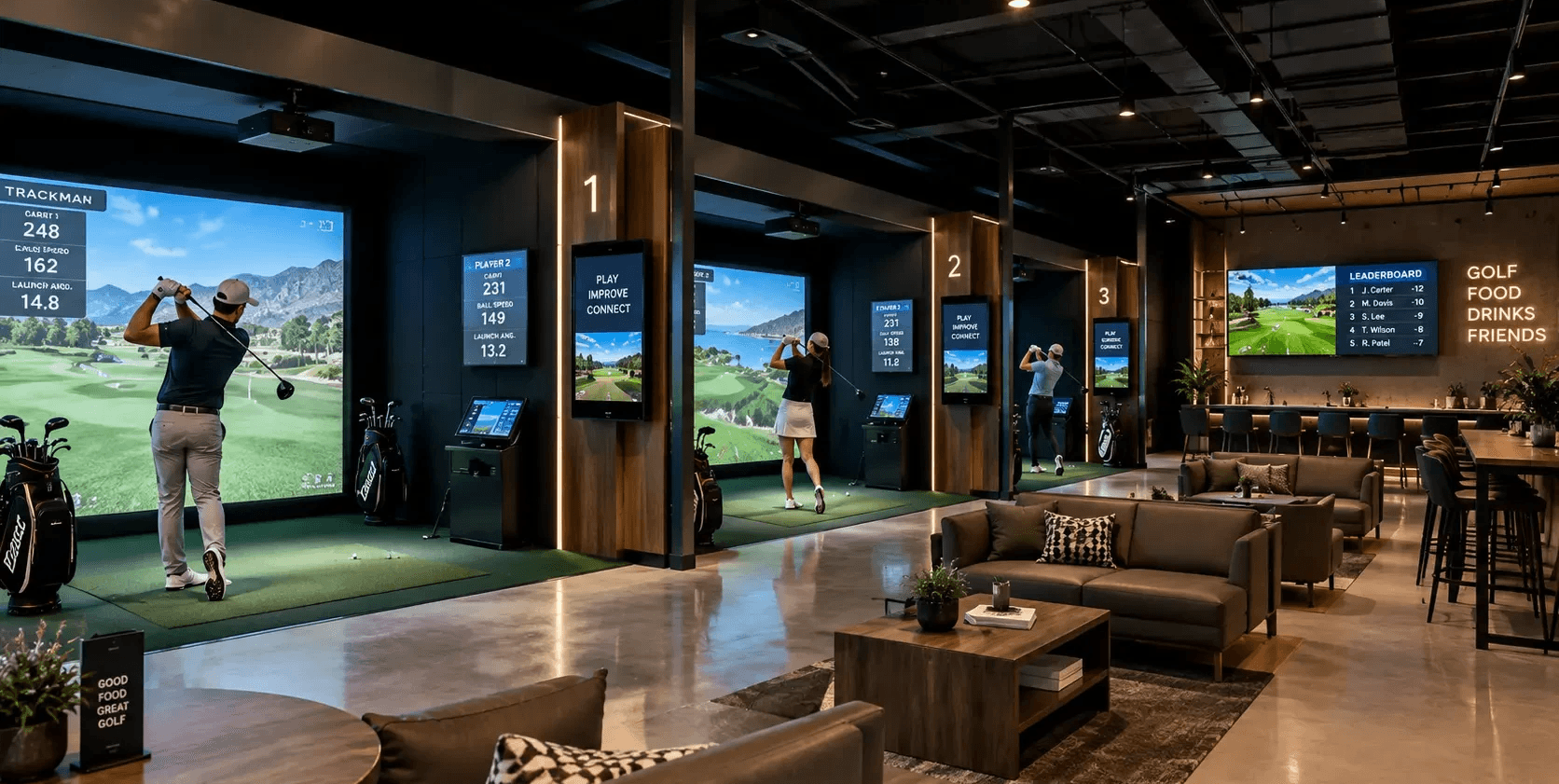
Indoor golf venues use digital signage to sell the hours they struggle to sell: weekday mornings, early afternoons, and the shoulder time before league night. The demand is there. A record 48.1 million Americans played golf in 2025, and 19 million of them played off-course only, at simulators, tech-enabled ranges, and entertainment venues, according to the National Golf Foundation. Your bays are already full at 7 pm on a Tuesday. The number that decides whether your venue clears its lease is bay utilization across the week, and screens are one of the cheapest levers you have.
The real KPI is bay hours sold, not foot traffic
Most simulator venues run 8 to 16 bookable hours per bay per day. Peak covers maybe a third of them. Every unsold bay hour is gone permanently, the same way an empty hotel room is. So the question for your screens is narrow: does what plays on the wall move people from a one-off booking into a membership, a league, a lesson package, or a return visit at an off-peak time?
That framing changes what you put on the TVs. Live sport keeps the room warm. It does not sell Wednesday at 11 am. A short, repeating loop that names the off-peak offer, the price, and the way to book it does.
Every unsold bay hour is gone permanently, the same way an empty hotel room is.
What to run on your screens
Off-peak rate cards, shown by daypart, so the 6 pm crowd sees the daytime price they can come back for.
Membership math, stated plainly: monthly fee, included bay hours, guest privileges, break-even in visits.
League and event calendars with spots remaining, updated weekly.
Lesson and club-fitting availability, with the pro's name and the next open slot.
Food and drink attach: the beer-and-bay bundle, the wing special, the group package minimum.
Keep each frame to one idea and one action. Players are watching their own ball flight on a much bigger screen a few feet away. Your signage wins short glances between shots and during the walk to the bar.
Rule of thumb for bay venues: put one screen where people wait to be seated, one behind the bar, and one in the sight line of the bay lounge seating. That covers the three moments when a player is idle and open to an offer.
Where the ad network changes the math
This is where indoor golf differs from most retail. Your audience is unusually valuable to advertisers: adults 30 to 55, disposable income, long dwell time, and a venue where they are relaxed and social for 60 to 120 minutes. That combination is what place-based advertisers pay for, and demand is climbing. Place-based out-of-home advertising revenue rose 19.3 percent year over year in Q2 2026, and digital out-of-home grew 18.5 percent to reach 38.4 percent of all OOH revenue, per the Out of Home Advertising Association of America.
Beam lets you open your idle screen time to approved third-party advertisers through the Beam Network. Your own promotions run first. The remaining slots can carry paid ads from brands that want exactly your room. That turns a screen from a cost line into a small revenue line, and it runs in the hours you were struggling to sell anyway.
Be honest about what screens can and cannot prove
Signage attribution is directional. You will not get a clean click-to-purchase trail the way you do with paid search. What you can do is run a controlled test: pick one off-peak block, run a dedicated promo code or a signage-only offer on the screens for four weeks, and compare bookings in that block against the four weeks before. Correlation is not proof, and weather, seasonality, and league schedules all move your numbers. Run the test long enough to see past them, and treat the result as a signal rather than a verdict.
How Beam helps
Runs on the TVs you already own, with a small player, so you skip commercial display costs.
Schedules content by daypart, so weekday-morning screens promote weekday-morning rates.
Updates every location from one dashboard, useful once you open bay number two or venue number two.
Opens unsold screen time to vetted third-party advertisers through the Beam Network, with category controls so competing venues and off-brand categories stay off your walls.
Features | Screens as decoration | Screens as a promo channel | Screens on the Beam Network |
Setup cost | Low | Low–Medium | Low–Medium |
Weekly effort | Very low | Medium | Low |
Effect on bay utilization | Minimal | Can promote offers and events | Can support offers, events, and customer engagement |
Monthly revenue | $0 | $0 directly | Potential advertising revenue |
Start with one bay lounge
Pick your slowest daypart. Build a five-frame loop for it. Run it for a month and watch bookings in that block. If the loop earns its keep, extend it to the bar and the entrance, then open the leftover slots to advertisers.
See how Beam turns your venue's screens into booked bay hours and monthly ad revenue at usebeam.io
Sources
Do I need commercial displays for a simulator venue?
No. Consumer TVs work for most indoor golf venues, since screens run during business hours and not around the clock. Buy commercial panels only for locations with heavy glare or 16-plus hour days.
How many screens does a typical indoor golf venue need?
Three to five covers most single-location venues: entrance or check-in, bar, and one or two in the bay lounge seating. Add screens per bay only if you are running per-bay promotions or sponsor content.
Will third-party ads irritate my members?
They are more tolerated than most owners expect, provided the mix is right. Keep paid slots to a minority of the loop, block competing categories, and keep your own membership and league content in the majority of rotations.
How long before signage affects bay utilization?
Plan on four to eight weeks before the numbers say anything useful. Booking behavior for off-peak hours changes slowly because it requires people to rearrange their week.
What content should never go on a golf venue screen?
Long text blocks, dense price grids, and anything requiring more than three seconds to read. Players glance. Design for the glance.
Can I still show live sport?
Yes. Most venues split screens by role: sport on the bar TVs, promotional loops on the entrance and lounge screens. Beam schedules the promo screens independently.