How Physical Therapy Clinics Use Digital Signage to Lift Plan-of-Care Completion and Earn From Waiting-Room Screens
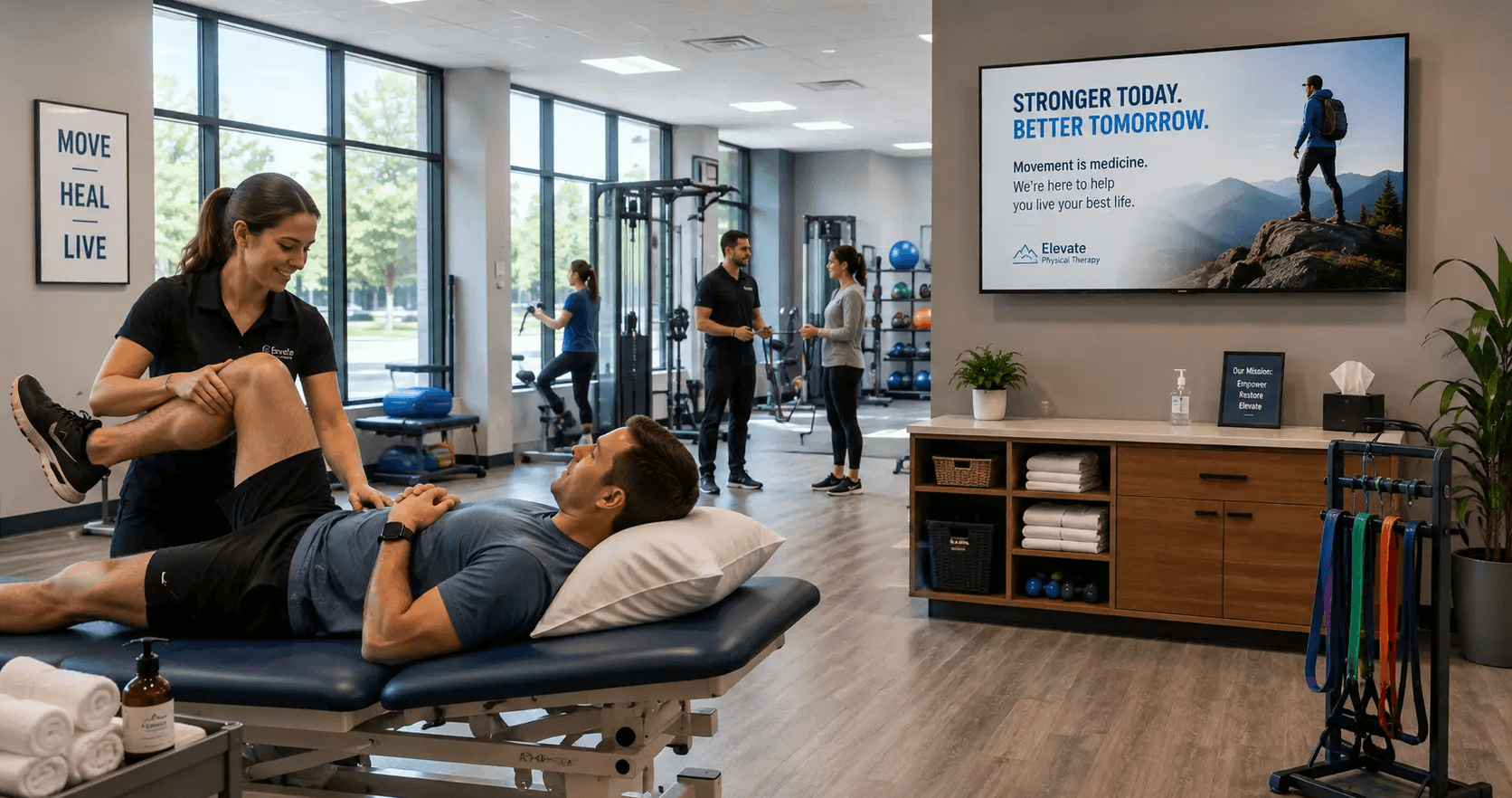
Outpatient physical therapy clinics use digital signage for two jobs: reinforcing the plan of care where patients actually wait and train, and earning money from screen time the clinic already pays to run. The business case starts with attendance. Peer-reviewed research on outpatient physical therapy reports no-show and cancellation rates ranging from 10% to 73%, with associated revenue losses of up to 50.6%. A screen will not fix a broken scheduling process, but it can carry the handful of messages that keep a patient showing up through visit twelve.
Name the KPI: plan-of-care completion
For a clinic owner, the number that pays the lease is visits per case, tracked in most practices as plan-of-care completion. A case that stops at visit four instead of visit twelve costs you eight billable visits you already earned through evaluation, authorization, and intake. It also costs the outcome, and outcomes are what keep the orthopedic group down the street sending referrals.
Attendance and home adherence move together. In a study of patients with low back pain, 43% adhered to the prescribed exercise program, and 31.7% discontinued treatment before completion, largely for logistical and access reasons. Those are information problems as much as motivation problems, and information is what a screen is good at delivering during dwell time you cannot otherwise use.
A case that stops at visit four instead of visit twelve costs you eight billable visits you already earned
What belongs on the screens
Patients spend 5 to 15 minutes in the waiting area and another 20 to 40 minutes in the gym with visible downtime between sets. Build a short loop, 90 to 120 seconds, and repeat it.
Plan-of-care explainers: why a course runs 8 to 12 visits and what stopping early costs in recovery time
Home exercise demonstrations: silent 10-second loops of your three most-prescribed movements, with rep counts on screen
Logistics: same-week rescheduling, authorization renewal steps, cancellation policy, parking
Progress framing: what week four typically feels like, so a plateau reads as normal instead of failure
Cash-pay services: dry needling, blood flow restriction, running gait analysis, recovery memberships
Design for silence. Waiting rooms run muted, so every slide needs to work with captions and large type read from 10 feet away.

Be honest about the limits
Signage influences behavior that you can observe, such as which cash-pay services patients ask about and how often they reschedule at the front desk instead of walking out. It does not prove causation. If completion rates rise after you install screens, staffing, scheduling software, and seasonality moved at the same time, treat the read as directional.
Two more limits worth stating plainly. Screens do not change your Google rankings; they can prompt patients to search your name or leave a review, and those behaviors matter, but the link to rankings is indirect. And do not offer anything of value in exchange for reviews, on screen or anywhere else, because that violates platform policy.
The second line: renting idle screen time
Most clinic screens run the same eight slides all day and generate nothing. Beam lets a venue open part of that loop to approved third-party advertisers and get paid for it. The clinic is the seller here, and the demand is real: out-of-home advertising revenue hit a record $9.46 billion in 2025, with digital out-of-home accounting for 36.3% of the total and growing 10.5% year over year, according to the Out of Home Advertising Association of America.
A waiting room is a high-value placement because dwell time is long and the audience is captive, which is exactly why category control matters. Health-adjacent venues should block categories that would embarrass the practice or contradict clinical advice.
How Beam helps
Beam runs the signage and the ad network in one place, so a clinic does not need two vendors or a media broker.
Runs on hardware you have: a standard smart TV plus a Beam player, no proprietary display purchase
Splits the loop: your plan-of-care and cash-pay content stays in rotation while paid slots fill the rest
Controls categories: approve or block advertiser categories before anything runs on your screen
Manages multiple sites: push a new authorization-renewal slide to every clinic location at once
Reports play: see what ran, when, and what the screen earned
How Beam helps in one line: your screens keep selling your plan of care, and the leftover time starts paying for itself.
Start with one screen
Pick your highest-dwell location, usually the waiting area, and run a 90-second loop for 60 days. Track plan-of-care completion and cash-pay inquiries before and after, and read the result as directional. Get started at usebeam.io.
Sources
Does digital signage in a waiting room violate HIPAA?
Displaying general education, clinic services, and third-party ads does not involve protected health information, so it sits outside HIPAA. Avoid putting patient names, appointment lists, or any identifying detail on a public screen.
How much content does a physical therapy clinic need?
Start with 8 to 12 slides on a 90 to 120 second loop, then refresh the promotional slides monthly. Evergreen items such as home exercise demonstrations and rescheduling instructions can run for a full quarter without changes.
Can I run ads without annoying patients?
Yes, if you cap the paid share of the loop and control categories. Most clinics keep paid slots to roughly a quarter to a third of the loop and block anything clinically contradictory.
What can a clinic realistically earn from screen advertising?
Earnings depend on foot traffic, dwell time, market, and the number of screens, so treat any single figure as a range rather than a promise. A single-location clinic should expect the revenue to offset the cost of running signage before it becomes meaningful profit.
Do I need a new TV to get started?
No. A recent smart TV with an HDMI port and stable Wi-Fi works with a Beam player, which is why most clinics start with a screen already on the wall.
How do I know whether it worked?
Compare plan-of-care completion and cash-pay inquiries across matched periods, and ask front-desk staff what patients mention. Signage attribution is directional, so pair the numbers with qualitative feedback instead of claiming a clean causal lift.