How Banks and Credit Unions Use Digital Signage to Lift Cross-Sell and Earn From Branch Screens

Banks and credit unions use digital signage to move members toward the products that pay: auto loans, credit cards, CDs, and second accounts. The branch audience is small but high intent, which is exactly why it works. In a June 2025 Drive Research survey of 1,000 U.S. consumers, 71% said in-person access still matters, and 42% turn to a bank representative for financial advice, so the people in your lobby are the ones most open to a recommendation.
Member growth is getting harder to win. Credit union membership across federally insured institutions reached 144.7 million in the fourth quarter of 2025, yet the median credit union lost ground: its membership fell 0.5%, and about 55% of federally insured credit unions ended the year with fewer members than they started. Aggregate growth hides a fight for share of wallet at the branch level. Screens give you a low-cost way to make every visit work harder.
The branch audience is small but high intent, which is exactly why it works
Name the KPI: cross-sell, applications, and retention
Skip generic engagement. The numbers that move a branch P&L are products per household, applications started for loans and cards, and member retention.
Point your screens at those three:
Cross-sell: promote the next product a checking-only member likely needs, such as an auto loan, a HELOC, or a high-yield CD.
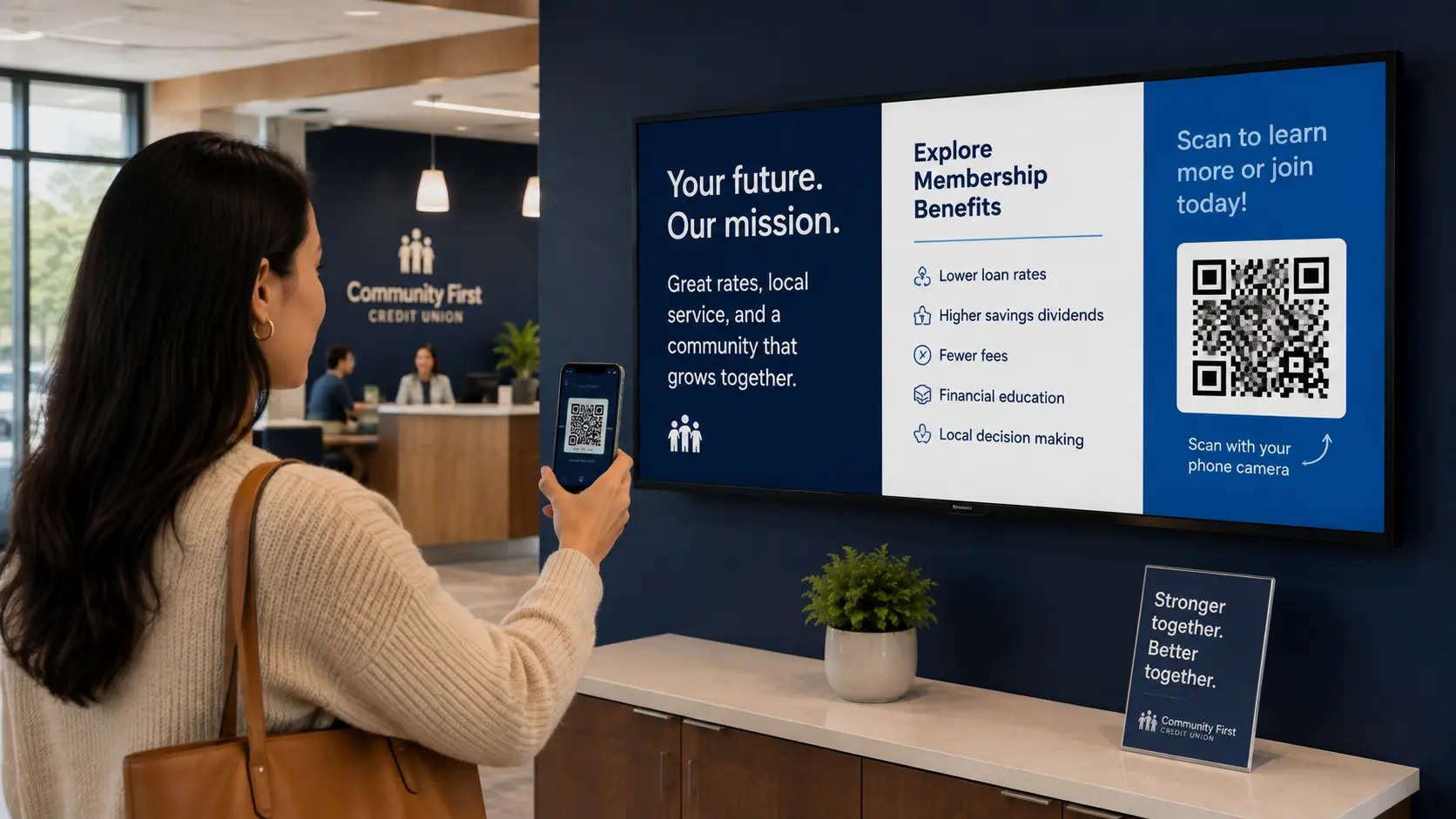
Applications: pair each offer with a QR code that opens an application or books time with a banker.
Retention: reinforce member benefits, fraud protection, and app features so the relationship deepens.
What to put on branch screens
Keep the loop short and tied to the moment. A few formats earn their place:
Rate boards for CDs, money markets, and auto loans, updated the day rates change.
Product spotlights that match the season, such as tax-time IRAs or back-to-school budgeting.
Digital tool prompts that push app downloads, mobile deposit, and card controls.
Wait-time content, such as local sports and weather, so the queue feels shorter.
Compliance first
Any advertised rate carries required disclosures. Advertised APYs fall under Truth in Savings, loan APRs fall under Truth in Lending, and deposit messaging should include your "insured by NCUA" or "Member FDIC" line. Route screen content through the same review as your print and web ads.
The honest limits
Signage is one input, not a growth engine on its own. Branch traffic is thin: in the same survey, only 2% of consumers visit a branch daily, and most in-person visits happen every few months. Screens reach fewer people than your app, so treat them as a high-intent channel rather than a mass one. Attribution is directional too.
A screen can prompt a member to ask about a CD or scan a QR code, but you cannot cleanly credit a screen for a funded loan. Track the behaviors you can see, such as QR scans, application starts, and banker referrals, and read them as signals.
Where the ad network fits
Most banks run their own message on every screen, and that is the right default for a regulated lobby. Beam supports that fully. If you also want to offset hardware and content costs, Beam lets you open idle screen time to approved third-party advertisers through the Beam Network, with category controls so you can block competitors and keep off-brand ads out.
You decide how much time, if any, goes to outside ads. Out-of-home is a strong medium to sell into: studies attributed to the Out of Home Advertising Association of America report that around 70% of adults recall OOH ads and roughly three in four act after seeing a digital out-of-home ad, though those figures often reflect first exposure and read as directional.
How Beam helps
Beam runs on the TVs you already own and centralizes control so a small marketing team can manage every branch. With Beam, you can:
Update rate boards and offers across all locations from one dashboard the moment rates change.
Schedule content by branch, daypart, and season so each lobby shows the right message.
Add QR codes and calls to action that route members to applications or to a banker.
Open idle screen time to vetted advertisers through the Beam Network when you want added revenue.
Put your branch screens to work
Your lobby already has the audience, and often the hardware. Point both at the products that grow member value. See how Beam runs your screens and, when you want it, turns idle time into revenue at usebeam.io
Sources
NCUA, Fourth Quarter 2025 Credit Union System Performance Data: https://ncua.gov/newsroom/press-release/2026/ncua-releases-fourth-quarter-2025-credit-union-system-performance-data
Drive Research, Banking Trends and Statistics: Insights From 1,000 Consumers (June 2025): https://www.driveresearch.com/market-research-company-blog/banking-trends-statistics/
Digital Signage Today, OOH advertising catching consumer attention across industries: https://www.digitalsignagetoday.com/news/ooh-advertising-catching-consumer-attention-across-industries/
Billboard Insider, New Data Reveals OOH Posts Lowest CPM and Highest Ad Recall in 2025: https://billboardinsider.com/new-data-reveals-ooh-posts-lowest-cpm-and-highest-ad-recall-in-2025/
Will digital signage directly increase our deposits or loan volume?
Not on its own. Signage prompts in-branch behaviors like asking about a product, scanning a QR code, or starting an application. Those can lead to funded accounts, but attribution is directional, so track scans, application starts, and referrals rather than crediting screens for the final dollar.
Can we keep third-party ads off our screens?
Yes. Running only your own content is the default. If you ever opt into the Beam Network, category controls let you block competitors and restrict ad categories, and you set how much time goes to outside ads.
What content works best in a bank or credit union lobby?
Short loops tied to the visit: current rates, one or two product spotlights, digital tool prompts, and light wait-time content like local weather. Refresh rates the day they change and rotate offers by season.
How do we stay compliant when we advertise rates on screens?
Treat screens like any other ad channel. Advertised APYs follow Truth in Savings, loan APRs follow Truth in Lending, and deposit messaging should include your "insured by NCUA" or "Member FDIC" language. Route screen creative through your normal compliance review.
Branch visits are declining. Is signage still worth it?
Traffic is lower but intent is higher. Only 2% of consumers visit a branch daily, yet 71% say in-person access matters and 42% seek advice from bank staff, so the branch remains where advice-heavy products get sold. Signage supports those conversations.
Do we need new TVs and hardware?
Usually not. Beam runs on standard screens you likely already have and manages them centrally, so most branches start with existing hardware and add players only where a screen is missing.