How Brewery Taprooms Use Digital Signage to Lift Average Check and Earn From Slow Weekday Hours
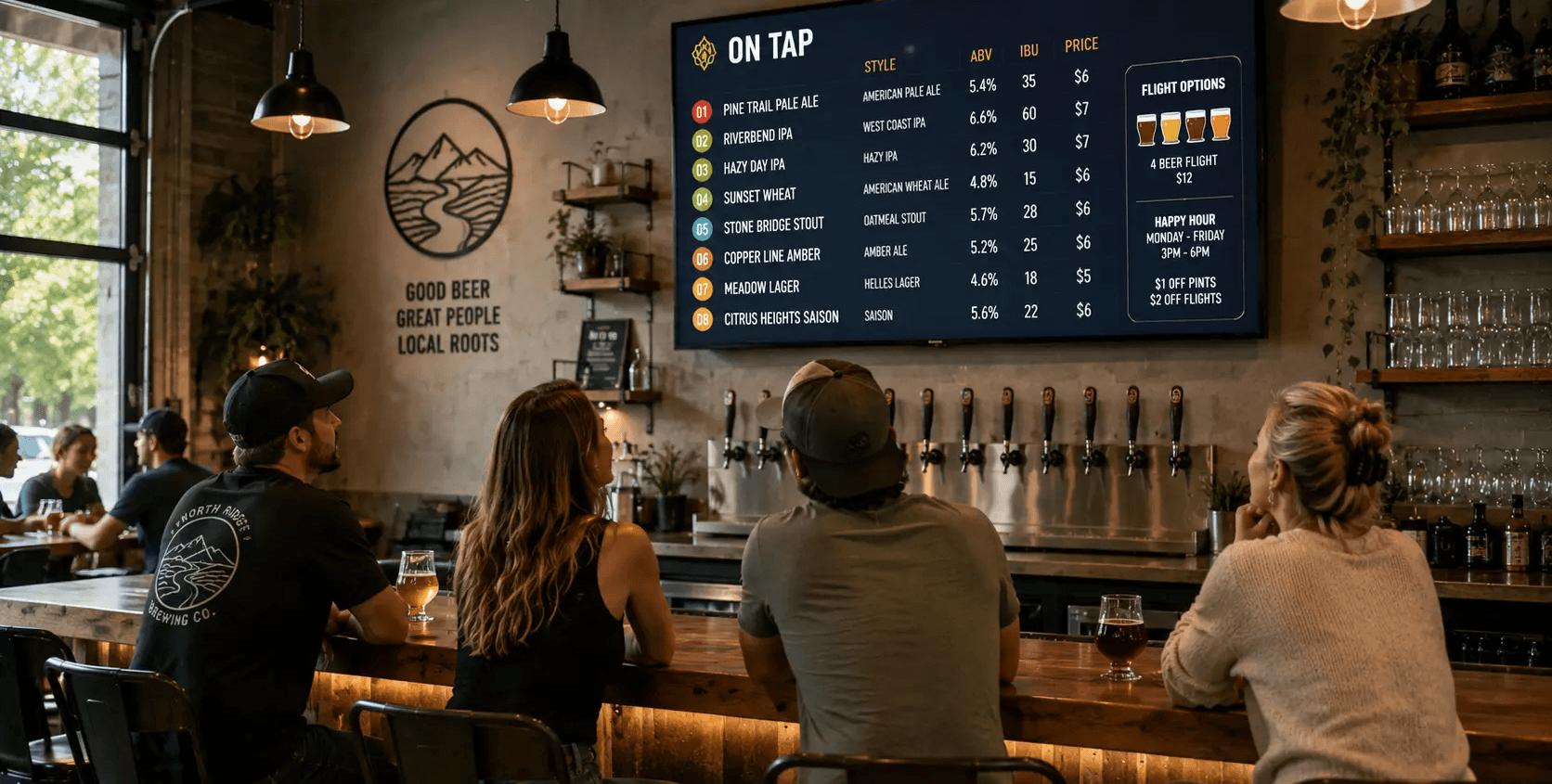
Digital signage does two jobs in a taproom. It steers guests toward higher-margin pours, flights, and merch during the 30 seconds they spend reading the board, and it turns half-empty hours into paid ad time. About three in four on-premise drinkers know their drink category before entering a venue, which leaves roughly one in four deciding after they arrive, per CGA by NIQ research published in 2025. That last quarter is what a well-built tap list screen is competing for. The figure comes from Canadian on-premise data, so read it as directional for a U.S. room.
The taproom is a decision room, not a waiting room
Most signage advice is written for lobbies, where the goal is to fill dead time. A taproom is different. Your guest is at the rail, scanning a list, choosing between a $7 pint and a $12 pour of the barrel-aged release.
That choice matters more now because on-site sales are carrying the segment. The Brewers Association reported that in the first half of 2025, taproom and brewpub models outperformed distribution-focused models by 1 to 2 percentage points. The room is where the margin is, so it deserves better merchandising than a smudged chalk wall.
The screen is the last thing a guest reads before they order
What actually belongs on a taproom screen
Keep the tap list as the anchor, then work the margin around it. A workable rotation:
Live tap list with ABV, price, and a "pouring low" flag on the kegs you want to move
Flight builder prompt that shows a four-pour flight next to the price of two pints
One featured pour per shift, tied to what your brewer wants sold this week
Merch board that shows the shirt, the crowler, and the gift card as products, not as clutter behind the register
Event calendar with the next three dates only, so trivia night and the food truck read as plans, not as a wall of text
Merch is the most underworked line. The Brewers Association benchmarking survey put merchandise at $44.03 per barrel in 2023 against $1,511.35 in total revenue per barrel, so it is running near 3 percent of the top line. A shirt shown at eye level costs nothing to display and carries a margin your beer cannot match.
Short beats clever. Two lines per slide, eight seconds per slide, and no video with sound.
Menu-labeling rules apply when you serve food, and alcohol advertising rules vary by state. Check what your state liquor authority allows on-premise before you promote pricing, discounts, or happy hour on a screen.
The second job: selling the hours you cannot fill
Most taprooms are busy Thursday through Sunday and quiet the rest of the week. The screens run anyway. That idle time has a market value, because advertisers are actively buying screens in real venues. Out of home advertising hit a record $9.46 billion in the United States in 2025, and digital out of home grew 10.5 percent year over year to reach 36.3 percent of the total, per the Out of Home Advertising Association of America.
Beam's network lets you open a share of your screen time to approved third-party advertisers while keeping your own tap list in the primary rotation. You set the split, you approve the categories, and you keep competing breweries off your wall. On a slow Tuesday afternoon, the screen earns instead of idling.
Measure the check, not the impressions
Skip generic engagement numbers. Track the KPIs a taproom owner already runs:
Average check per guest, split by weekday and weekend
Flight attach rate as a share of total tickets
Merch attach rate and merch dollars per 100 tickets
Keg velocity on the featured pour versus the prior two weeks
Net ad revenue per screen per month
Pull the first four from your POS. Run a featured pour on the screens for two weeks, then compare against a two-week baseline for the same days of the week.
Be honest about what signage cannot prove
In-venue signage has no click, so you will not get a clean attribution trail from screen to sale. Treat the read as directional. A featured pour that moves 20 percent more kegs during a screen push, on comparable days with comparable traffic, is a real signal and not proof of causation. Weather, an event, and a bartender who likes that beer all move the same number.
Signage also does not change your Google ranking. It can lead to more branded searches and more reviews from guests who had a better visit, but the screen is not an SEO tool.
How Beam helps
Beam runs your taproom screens as managed signage and gives you the option to earn from them. You schedule the tap list and event board across every screen from one dashboard, push a keg change from your phone, and reuse the same layout at a second location. Then you decide how much idle time goes to the Beam Network, approve the advertiser categories you want, and block the ones you do not.
Ready to see what your screens are worth on a Tuesday afternoon? Start at usebeam.io and get your tap list and your ad revenue running on the same screens.
Sources
Do I need commercial displays for a taproom?
Consumer TVs work for most taprooms running 8 to 12 hours a day. Commercial panels earn their premium in direct sunlight, in portrait orientation, or past 16 hours a day.
Will ads on my screens annoy regulars?
Guests read the tap list and mostly ignore third-party spots the way they ignore the TV in the corner. Keeping your own content in the majority of the rotation is what keeps the room feeling like yours.
How many screens does a taproom need?
Two or three cover most rooms: one anchor above the taps, one at the entry, and one on the patio or in the event space. More screens split attention without adding sales.
Can I block competing breweries from advertising on my screens?
Yes. You set category and brand blocks before anything runs.
How long before I see a change in average check?
Give a featured pour two full weeks against a matched baseline. Merch attach takes longer, because it depends on guests seeing the product across several visits.