How Do You Make Money From Digital Signage?
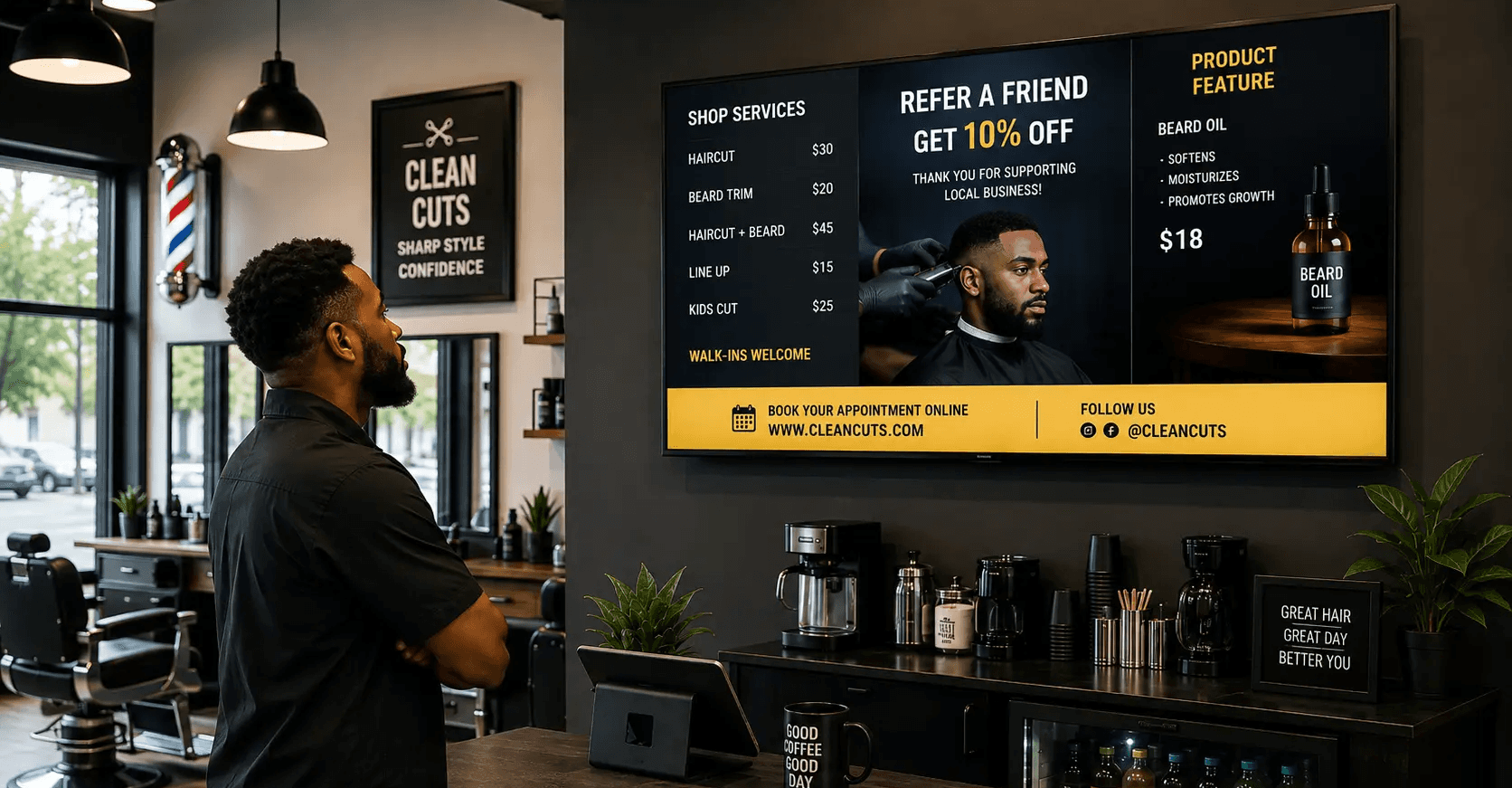
You make money from digital signage in two ways: you sell idle screen time to advertisers, and you use the same screens to lift your own sales. The advertiser side is real money. U.S. out-of-home ad revenue hit a record 9.1 billion dollars in 2024, and digital screens were the fastest-growing part of that spend at about 34 percent of the total, according to the OAAA.
The rest of this guide breaks down both paths, what a screen can realistically earn, and where the money actually comes from.
The two ways a screen pays you back
Most owners treat a TV in their space as a cost. It runs a menu, a promo loop, or a news channel, and the electric bill shows up every month. Digital signage flips that. The same screen can hold two revenue streams at once.
The same screen can hold two revenue streams at once
Sell your idle screen time to advertisers
Your screens run all day, but your own content only needs a slice of that time. The rest sits idle. An advertising network fills those open slots with paid ads from approved third-party brands and pays you a share. This is the passive-income path, and the pool behind it is growing fast. Programmatic DOOH spending, the automated buying that fills screens like yours, is projected to rise about 23 percent year over year, per MAGNA.
Advertisers pay for this time because it works. In Nielsen research for the OAAA, 74 percent of people who saw a digital out-of-home ad took an action afterward, such as searching for the advertiser or visiting its website. Attention on a screen in a real place turns into measurable behavior, which is why brands buy it.

Lift your own sales with the same screens
The second stream is your own margin. When you use screen time to promote high-margin items, bundles, or add-ons, you influence what people buy while they wait or shop. A 2026 study in the Journal of Marketing, based on 237 campaigns and 30 million shoppers, found that in-store digital signage increased the likelihood of buying a featured product by 8.1 percent, with an average gross return on ad spend of around 21 percent.
Treat that as directional, not a promise, but the direction is clear and consistent.
So how much can one screen earn?
Honest answer: it depends, and the number to watch is revenue per screen per month plus how fast the screen pays back its hardware cost. Ad revenue is not fixed. It moves with a few things:
Foot traffic: more eyes per hour means more the network can charge.
Dwell time: waiting rooms, salons, and laundromats hold attention longer than a quick checkout line.
Location: a screen in a dense, high-value area earns more than one in a quiet spot.
Screen count: more screens mean more inventory to sell.
Fill rate: not every slot sells every day, so treat ad income as variable.
Set the expectation as a payback timeline. A screen that offsets its own hardware and a chunk of your monthly costs, then adds in-store lift on top, is a win. Think of it as a steady monthly offset that grows as you add screens.
What this path does not do
Screens influence behavior in the room. They do not change your Google rankings, and signage attribution stays directional, so resist the urge to credit every sale to the TV. The advertiser-action figures above are averages across many campaigns, and your results will vary with your traffic and product mix. Being clear about the limits is how you plan around them.
How Beam helps
Beam runs both streams from one place. The Beam Network matches your idle screen time with approved advertisers and pays you a revenue share, while you keep the rest of the loop for your own promos. You approve which advertiser categories can run, so nothing off-brand shows up next to your menu. You manage every screen, your own content, and the paid ads from a single dashboard.
A barbershop with two screens can run its own service menu and rebooking prompts, let the network fill a share of the loop with paid ads, and watch both the ad payout and the upsell land in the same report.
Start earning from your screens
If you already have a TV in your space, it can start paying you back. See how the Beam Network turns idle screen time into revenue at usebeam.io
Sources
OAAA, Out of Home Advertising Revenue Surpasses 9 Billion: https://oaaa.org/news/out-of-home-advertising-revenue-surpasses-9-billion-highest-revenue-volume-to-date/
MAGNA Advertising Forecast: https://magnaglobal.com/ad-forecast-media-innovation-to-propel-the-global-ad-market/
Journal of Marketing (2026), In-Store Advertising with Digital Signage: https://journals.sagepub.com/doi/10.1177/00222429251351578
Nielsen for OAAA, DOOH Engages Consumers and Drives Activations: https://oaaa.org/blog-posts/nielsen-research-dooh-engages-consumers-and-drives-activations/
Is digital signage really passive income?
Partly. The ad-network share is close to passive once your screens are set up, but income varies with your traffic and fill rate, so treat it as a steady offset rather than a fixed paycheck.
Do I need special hardware to earn from my screens?
You need a screen and a media player or a compatible device to run the network. Most modern TVs work, and the payback timeline on that hardware is the number to track.
Will paid ads make my space look cluttered or off-brand?
Only if you let them. With Beam, you approve advertiser categories and keep a share of the loop for your own content, so the screen still reflects your business.
How fast will I see revenue?
It depends on foot traffic, dwell time, and how many screens you run. Higher-traffic, longer-dwell spaces like waiting rooms and laundromats tend to fill slots and pay back faster.
Can I still promote my own offers?
Yes. Your promos and the paid ads share the same loop, so you can push high-margin items and bundles while the network fills the open slots.
Does signage help my sales even without ads?
It can. A 2026 Journal of Marketing study found in-store screens raised the likelihood of buying a featured product by 8.1 percent, though results vary by store and product.