How Property Managers and HOA Boards Use Digital Signage to Lift Renewals and Earn From Lobby Screens
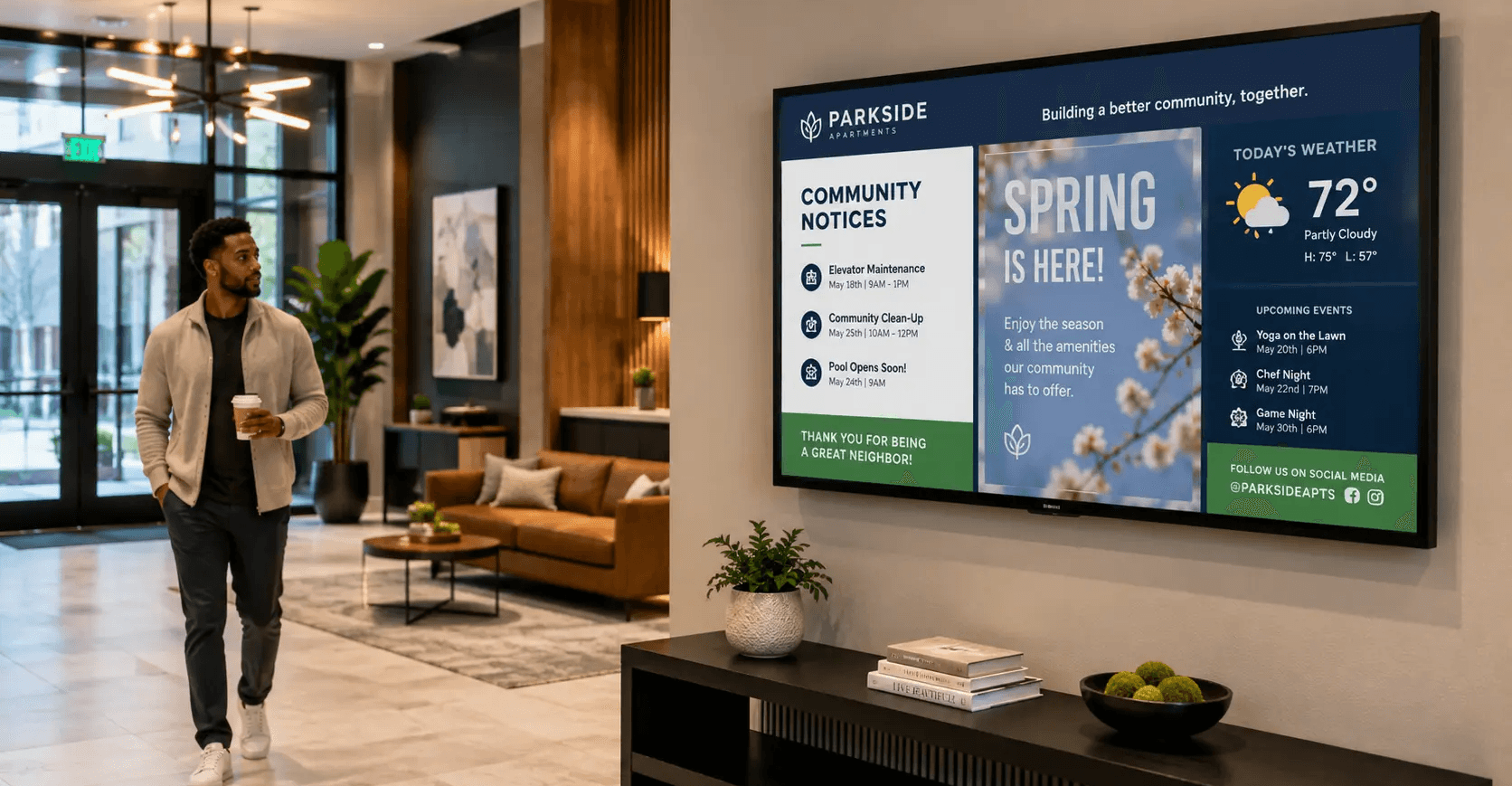
Lobby and clubhouse screens do two jobs for a residential property: they cut the repeat questions that eat leasing-office hours, and they turn a wall you already own into a revenue line. The second job is the one most boards overlook. Digital out-of-home advertising grew 10.5% year over year in 2025 and now accounts for 36.3% of all out-of-home revenue, according to the Outdoor Advertising Association of America. Advertisers are paying for exactly the kind of captive, repeat foot traffic a residential lobby produces every morning.
The KPI that matters: renewal rate, not "engagement"
Property managers do not get paid for impressions. They get paid for renewals and net operating income. Roughly 54% of market-rate apartment renters renewed their leases as of late 2024, up 120 basis points year over year, per RealPage data cited in 2025 multifamily industry analysis. Every point of renewal you hold is a turn you do not pay for. The National Apartment Association estimates that marketing, vacancy, and repair costs on a single turnover can exceed $4,000 per unit.
So the honest question for a lobby screen is not "did residents look at it?" It is whether the screen reduces the friction that makes residents leave: missed package notices, surprise water shutoffs, amenity closures nobody announced, an HOA meeting the board swore it publicized.
Property managers do not get paid for impressions. They get paid for renewals and net operating income.
What actually goes on the screen
Residents ignore screens that repeat the same three slides for a month. The properties that get value out of signage run a tight rotation of information residents cannot get faster somewhere else. Such as:
Maintenance and outage notices, posted the hour they are scheduled.
Amenity hours, closures, and pool or gym capacity
Package room status and pickup deadlines
HOA and board meeting dates, agendas, and voting deadlines
Community events, resident spotlights, and new-neighbor welcomes
Renewal windows and referral bonus reminders
Email still wins for one-to-one communication. In the 2024 NMHC and Grace Hill Renter Preferences Survey of 172,703 renters, email was the overwhelmingly preferred channel for both leasing questions and non-emergency maintenance requests. Screens are not a replacement for that. They are the ambient layer that catches the resident who never opened the email, on the walk between the mailroom and the elevator.
Set a content owner and a weekly slot. A screen with a stale slide is worse than a blank wall, because it teaches residents to stop looking.
The part boards miss: the screen can pay for itself
Here is where a residential property differs from a coffee shop. Your lobby has predictable, repeat, high-dwell traffic from a known demographic in a known ZIP code. That is a premium inventory profile for local advertisers: the dentist two blocks over, the regional gym chain, the moving company, the credit union.
Most of your screen time is idle. Community notices fill maybe a fifth of the loop. The rest is a slideshow of stock photos.
Beam lets you sell that idle time. Your community content stays in the rotation and stays first. The remaining slots go to approved third-party advertisers through the Beam Network, and the property collects a share of the ad revenue.
For an HOA, that is a line item that offsets the amenity budget without a dues increase. For a management company, it is ancillary revenue across an entire portfolio of lobbies you already staff and power.
Be honest about what signage cannot prove
Signage attribution is directional. Nielsen research for the OAAA found that nearly two-thirds of DOOH viewers took at least one action after exposure, and 52% of smartphone owners engaged on their phone after seeing a digital screen. That is strong evidence the format works. It is not evidence that your lobby screen caused a specific renewal.
Treat signage the way you treat landscaping or a clean gym: a contributor to resident satisfaction that you measure indirectly, through renewal surveys, service-request volume, and event attendance. If your leasing office logs 30 fewer "when does the pool reopen" calls a month, the screen is doing its job.
How Beam helps
Beam runs on standard TVs. No proprietary panels, no rip-and-replace.
Push a water shutoff notice to every building in a portfolio from one dashboard, in under a minute.
Schedule slides by property, by building, or by screen
Keep community content prioritized while Beam fills idle slots with vetted local advertisers.
See revenue per screen, so the board can put a number in the budget instead of a hope.
Feature | Screen Used as a Bulletin Board | Screen on the Beam Network |
Content Control | Manual updates with limited scheduling | Cloud-based remote management with instant updates, playlists, and scheduling |
Advertiser Access | No advertiser access; only displays the owner's content | Businesses and brands can run targeted advertising campaigns across the network |
Revenue per Screen per Month | No direct revenue generated | Opportunity to earn recurring monthly advertising revenue (varies by location, audience, and campaign demand) |
Board Reporting | No analytics or proof of play | Real-time reporting, proof of play, campaign analytics, and performance insights |
Get a number for your next board meeting
Bring the finance question to the table with an answer already attached. See what your lobby screens could earn at usebeam.io
Sources
Does an HOA need to change its bylaws to run advertising on a lobby screen?
Usually not, but check. Many governing documents are silent on ancillary revenue, while others restrict commercial activity in common areas. Have counsel review before the board votes, and disclose the revenue arrangement to residents.
Who controls what ads appear?
The property does. Advertisers are approved before they enter the rotation, and categories can be excluded. Community notices always run ahead of paid slots.
How much screen time does community content actually need?
Most properties fill 15% to 25% of the loop with their own notices, even during a busy renewal season. The rest is idle time that can be monetized.
Will a screen in the lobby annoy residents?
It depends entirely on the content mix and refresh cadence. Screens that carry useful, current information get read. Screens that loop a stale welcome slide get ignored.
Can one manager run screens across multiple properties?
Yes. Beam is built for portfolio operators, with per-property and per-screen scheduling from a single dashboard.
Does signage improve online reviews or search visibility?
Signage can prompt behaviors that influence reputation, like review requests and event attendance. It does not directly change Google rankings, and anyone who claims otherwise is selling something.