How Do You Measure the ROI of Digital Signage?

You measure the ROI of digital signage by picking one business number the screens are meant to move, tracking it before and after you turn them on, and weighing the change against what the setup costs you. Vendor benchmarks put the return in the range of 4 to 6 dollars back for every dollar spent, with payback in 6 to 18 months, though the real figure depends on your content and your traffic. The screens do not create the return on their own. The number you choose to track, and the offers you put on screen, do.
Start with one KPI, not a full dashboard
Signage can influence several things at once. That makes it tempting to track everything and prove nothing.
Pick the single metric that matches your business and hold the screens accountable to it:
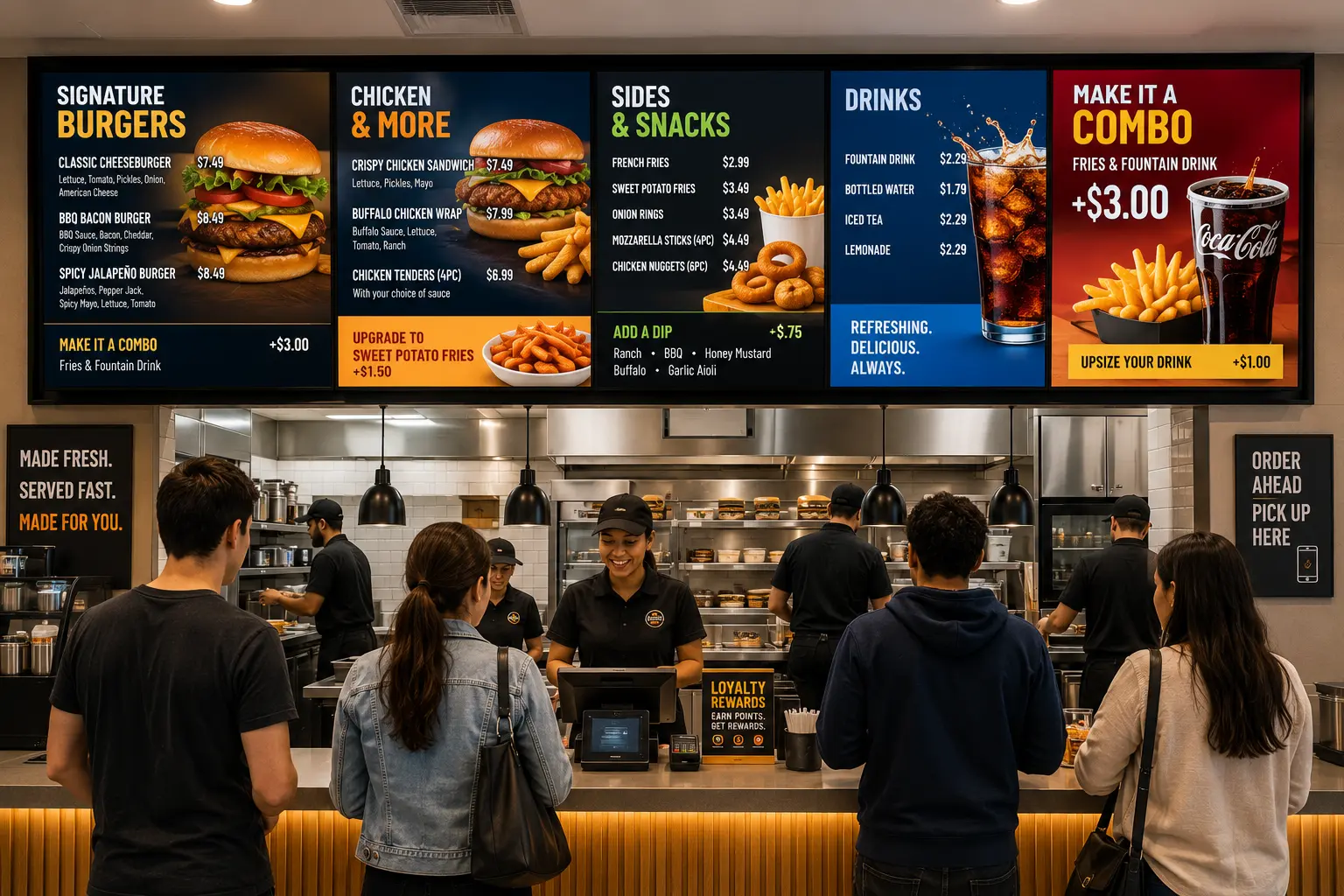
Restaurants: average order value and combo attach rate.
Gyms: member retention and upgrade sign-ups.
Auto repair and medical: approved work per visit, or wellness-plan enrollment.
Retail and boutiques: units per transaction and conversion rate.
Any local business: reviews and branded search, meaning people who look up your name after a visit.
Generic "engagement" is not a KPI. Revenue per customer, rebooking rate, and sign-ups are.
The math behind signage ROI
ROI is a ratio, not a feeling. Use this: value gained minus cost, divided by cost.
Value gained: the lift in your chosen KPI, converted to dollars. If average order value rises 80 cents across 6,000 monthly orders, that is 4,800 dollars a month.
Cost: hardware, mounting, your media player or software subscription, and the hours to build content. Spread one-time costs over the payback window.
In retail, studies point to sales lifts as high as a directional 33 percent where the content is strong, though results vary widely by execution. Run your own ratio for 90 days before you judge it. One slow week tells you nothing.
ROI is a ratio, not a feeling: value gained minus cost, divided by cost.
Why signage numbers are directional
Here is the honest part. Signage and digital out-of-home rarely give you a clean click-to-sale trail the way a search ad does. The IAB now publishes a DOOH measurement standard, but exposure is often modeled rather than counted person by person, so read footfall and attribution results as directional.
Out-of-home still shows real downstream effect. Comscore and the OAAA found that out-of-home fuels search, social, and site visits at roughly 5 to 6 times the rate you would expect from its share of ad spend, and 41 percent of US adults said they used a search engine after seeing an out-of-home ad. Those are behaviors you can watch, such as branded searches, direct visits, and review volume, even when you cannot tie each one to a single screen.
Honest limit
Signage drives actions like reviews, branded search, and repeat visits. It does not directly change your Google ranking, and it will not hand you a per-screen sales receipt.
Treat the trend, not the decimal point, as your signal.
A before-and-after test you can run this month
Pick one KPI and record four weeks of baseline.
Turn on the screens with one clear offer, not five.
Keep pricing, staffing, and hours steady so the screen is the main change.
Compare the next four weeks against baseline.
Repeat with a different offer to see which content earns its place.
This will not be a lab experiment. It will tell you, cheaply, whether the screens move your number.
How Beam helps
Beam gives signage ROI two sides most platforms miss. First, you build and schedule your own promotions from one place, so the offer on screen matches what you want customers to do. Second, and this is what sets Beam apart, you can open idle screen time to approved advertisers on the Beam Network and earn passive income from minutes your screens would otherwise waste.
Your return is not only the lift in your own KPI. It is also a revenue line from the same hardware. For a venue weighing the cost of screens, a second income stream shortens the payback window on the whole setup.
How Beam helps. One dashboard to run your promotions, plus a built-in ad network that pays you for idle screen time. Two returns from one screen.
See what your screens could earn and influence. Start at usebeam.io.
Sources
How long before digital signage shows a return?
Most businesses look at a 6 to 18 month payback window, and you need at least 90 days of data before the trend means anything.
What is a good ROI for digital signage?
Vendor benchmarks cite roughly 4 to 6 dollars back per dollar spent, but treat that as directional and measure against your own KPI rather than a headline number.
Can I track sales from one specific screen?
Usually not with precision. Signage attribution is modeled and directional, so watch overall lift in your KPI and downstream signals like branded search instead.
Which metric should a small business track?
Pick the one closest to revenue for your model, such as average order value, rebooking rate, or membership sign-ups. Skip generic engagement counts.
Does signage improve my Google ranking?
No. It can prompt reviews and branded searches that support your local presence, but it does not change search algorithms directly.
Can the screens pay for themselves?
They can, in two ways: by lifting your own KPI, and by earning ad revenue from idle screen time on a network like Beam.