How to Open a Hotel: Costs, Steps, and What to Know Before You Launch

Opening a hotel takes a concept, a feasibility study, funding, a site or property, licenses, construction or renovation, a brand decision, staff, and a launch plan, usually over 2 to 4 years for new builds. It is a capital-heavy business measured per room. A U.S. limited-service hotel costs about 167,000 dollars per room to develop in 2025, and guest spending across the industry reached a record 777 billion dollars, according to HVS and AHLA.
This guide covers the steps, the real costs, and the numbers to know before you commit.
Define your concept and market
Decide your segment and guest: economy, midscale, upscale, or luxury, and business, leisure, or extended-stay. A feasibility study tests demand, competition, and projected occupancy before you invest. The concept drives your site, brand, and budget.
Build a feasibility study and business plan
Hotels demand rigorous projections. Model occupancy, average daily rate, and revenue per available room against local benchmarks, plus staffing and operating costs. Conservative assumptions protect you, since 2025 saw the first full-year dip in occupancy and RevPAR since 2020.
Reality check on cost
Industry estimates put development near 150,000 to 200,000 dollars per room for economy hotels, 150,000 to 250,000 dollars for midscale, 300,000 to 500,000 dollars for upscale, and 1,000,000 to 2,000,000 dollars per key for luxury. Land and soft costs add significantly. Treat these as planning ranges, not quotes.
Development cost per room by segment
Segment | Typical cost per room |
Economy | 150,000 to 200,000 dollars |
Midscale | 150,000 to 250,000 dollars |
Upscale | 300,000 to 500,000 dollars |
Luxury | 1,000,000 to 2,000,000 dollars |
Secure funding
Hotels usually combine equity investors, a commercial or SBA loan, and sometimes brand or franchise financing. Lenders want a feasibility study, projections, and an experienced operator. Raise enough to cover land, construction, furniture and equipment, pre-opening, and a contingency reserve.
Choose a site or property
Decide whether to build, buy, or convert an existing building. Check zoning, access, visibility, and local demand drivers like airports, business districts, or attractions. Site selection shapes cost, permitting, and long-term performance.
Handle licenses, permits, and brand
Register your entity, then work through building permits, occupancy and fire approvals, health permits for food service, and a liquor license if you serve alcohol. Decide early whether to run independent or fly a franchise flag, since a brand affects standards, fees, and financing. Confirm requirements with your local authorities.
Conservative assumptions protect you in a market that can soften
Design, build, and furnish
Design the property for your segment and guest experience. Manage construction or renovation, then furnish rooms and public spaces with furniture, fixtures, and equipment. Soft costs like design and financing can reach 30 to 40 percent of the budget.
Set up operations and systems
Choose a property management system, a booking engine, and channel connections to online travel agencies. Plan revenue management to price rooms by demand. Strong systems drive occupancy and rate from day one.
Hire and train your team
Hire front desk, housekeeping, maintenance, and management, and train on service standards before you open. Service defines guest reviews, which drive future bookings. A soft opening lets the team rehearse the full guest journey.
Plan distribution and screens
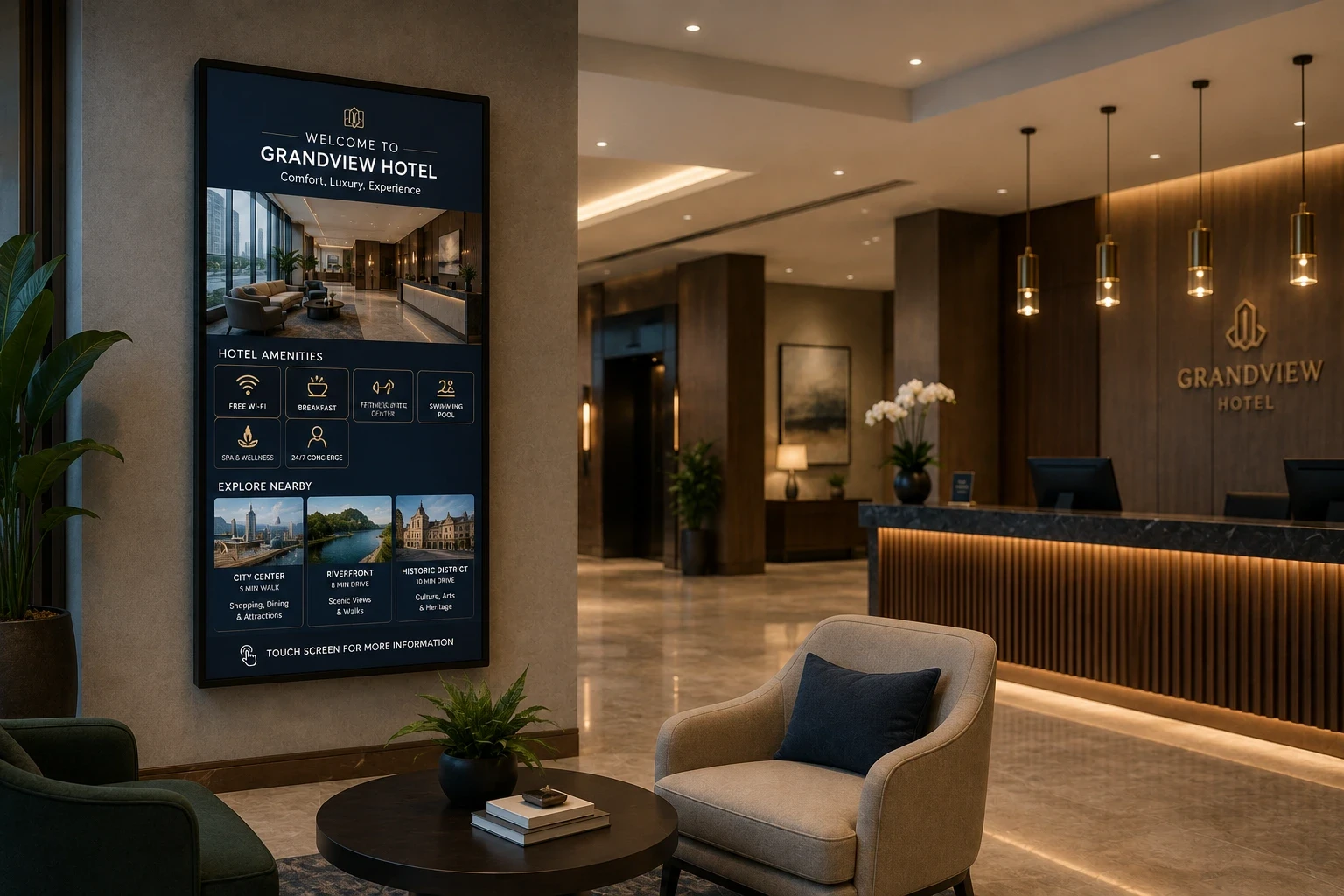
Set up your website, online travel agency listings, and a direct-booking path. Plan lobby, elevator, and in-room screens early, since wayfinding, amenity promotions, and upsells raise ancillary revenue per available room.
Plan your launch
Build demand before you open. Claim your listings, set up your Google Business Profile, and open with introductory rates to gather early reviews. Reviews and repeat guests drive occupancy, so make the first stays count. Ask happy guests for honest reviews, and never pay for or incentivize them.
How Beam helps once you open
Beam turns your lobby, elevator, and common-area TVs into managed digital signage you control from one dashboard, so wayfinding, amenity promotions, and event details update in minutes across every screen and property.
Ancillary revenue per available room is where hotels grow beyond the room rate, and screens promote the restaurant, spa, and upsells where guests pass by. The difference is what happens during idle time. Beam Network lets you open unused screen time to approved advertisers and earn passive income from screens you already run. You keep control, block competitors, and hold priority slots for your own content. Signage supports ancillary revenue rather than guaranteeing it, and screen attribution is directional.
How Beam helps. One dashboard for wayfinding, amenity promotions, and paid network ads, with full control over what runs on your screens
Open smarter with Beam
Plan your screens alongside your build-out. See how Beam runs property signage and monetizes idle screen time at usebeam.io
Sources
How much does it cost to open a hotel?
Industry estimates put development near 150,000 to 250,000 dollars per room for economy and midscale hotels, 300,000 to 500,000 dollars for upscale, and 1,000,000 to 2,000,000 dollars per key for luxury. Land and soft costs add significantly.
How long does it take to open a hotel?
A new-build hotel commonly takes 2 to 4 years, while a conversion or franchise can open faster. Feasibility, financing, permitting, and construction are the major phases.
What licenses do I need to open a hotel?
Requirements vary by location, and common ones include building and occupancy permits, fire and health approvals, a lodging license, and a liquor license if you serve alcohol. Confirm the exact list with your local authorities.
Should I run independent or franchise?
A franchise flag brings brand recognition, distribution, and easier financing, along with fees and standards. An independent hotel gives you full control of brand and operations. The right choice depends on your market and capital.
Do I need digital signage to open a hotel?
No, but screens earn their place quickly. They guide guests and promote amenities, and platforms like Beam let you offset costs by earning from idle screen time.