Hyperlocal Targeting with DOOH Advertising
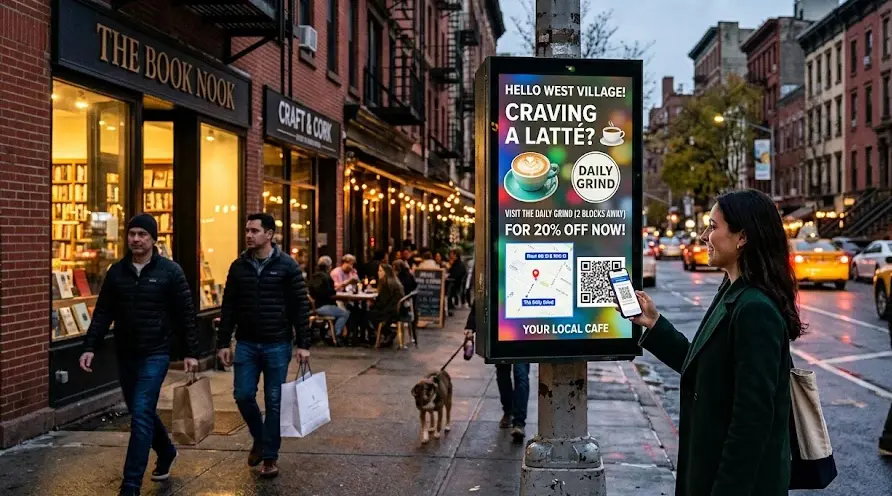
Hyperlocal targeting in DOOH (Digital Out-of-Home) advertising lets businesses deliver ads to specific neighborhoods, venues, and high-traffic locations by choosing exactly which digital screens run their content. The result is relevance: your message appears where your audience already is, at the moment they can act on it.
This guide explains how it works, why it performs, and where its real limits sit.
What Hyperlocal Targeting in DOOH Actually Means?
Hyperlocal DOOH targets by location, not by individual person. You select screens based on where they are: a specific street, a shopping center, a gym, a business district.
Everyone near that screen sees the ad, which makes this proxy targeting (you reach an audience because of where they are) rather than the person-level targeting of online ads. That distinction matters when you plan and measure campaigns.
You can focus on:
Individual streets or neighborhoods
High-traffic venues such as malls, gyms, and restaurants
Business districts or residential areas
How Hyperlocal DOOH Advertising Works
Digital signage platforms like Beam serve as the central dashboard. Users can:
Select Locations
Choose specific screens, venues, or geographic zones where your ads will appear.Assign Content
Adapt messaging based on location. A promotion can vary by neighborhood, time of day, or audience type.Schedule Campaigns
Define when ads should run based on time, day, or campaign duration.Publish and Monitor
Launch campaigns and track performance across selected locations.
Changes take effect instantly across your selected screens.
Why Hyperlocal DOOH Performs
Out-of-home is a high-attention, high-recall medium; Out-of-home delivers ad recall well above online and social averages, and roughly 73% of consumers view DOOH favorably, more than TV or social (OAAA).
Adding OOH to a media mix has been shown to lift social-media effectiveness by about 56% and digital performance by about 31% (OAAA). The format is growing fast for these reasons, with programmatic DOOH projected to grow around 23% in 2025 (MAGNA).
The specific advantages of going hyperlocal:
Relevance at the point of attention
Ads appear in environments tied to real decisions. A restaurant promotion near offices at lunchtime reaches people who can act immediately.
Efficient use of budget
Spend concentrates on locations that match your audience, reducing wasted exposure in places they aren't.
Speed and flexibility
Campaigns update remotely in minutes, with no reprinting or manual swaps, so you can react to performance, weather, or local events.
Localized messaging
Content can be tailored by neighborhood, daypart, or audience without producing entirely separate campaigns.
How Hyperlocal DOOH Works With A Platform Like Beam
Select locations
You can choose the specific screens, venues, or zones where your ads appear.
Assign content
You can adapt messaging by location, time of day, or audience.
Schedule campaigns
You can define when ads run by hour, day, or flight.
Publish and monitor
You can launch and track delivery across selected locations, with changes taking effect across screens.
Practical Use Cases
Some practical cases where DOOH advertising works are;
Retail Promotions
Retail stores promote in-store offers to nearby shoppers to lift foot traffic.
Event-Based Campaigns
Advertisers can target screens near event venues before and during events.
Local Business Advertising
Small businesses tightly geographic campaigns without paying for wide coverage they don't need.
Understanding Measurement (and its limits)
DOOH measurement has improved, but is still coarser than online. Because you target screens rather than individuals, "impressions" are typically modeled from foot-traffic and audience data, not from a one-to-one ad-served count.
Mobile-location and attribution partners can estimate exposure and even downstream store visits, but treat these as directional.
Plan around reach, frequency, and footfall in your chosen locations, and use available attribution tools to refine over time rather than expecting click-level precision.
Key Benefits of Hyperlocal DOOH Advertising
Precise targeting
Higher engagement from contextually relevant content
Efficient spending focused on high-impact areas
Scalable from one location to many
Real-time updates across your network
Best Practices for Hyperlocal Campaigns
Choose locations based on audience behavior and foot traffic, not convenience.
Tailor messaging to the local context.
Keep visuals clear and concise for quick comprehension.
Schedule ads during peak activity periods.
Monitor performance and refine targeting regularly.
Common Mistakes to Avoid
Selecting locations without audience insight.
Running identical content everywhere with no localization.
Overloading screens with too much information.
Ignoring timing and peak hours.
Setting and forgetting; not refining based on results.
How Beam Helps
Beam connects advertisers to a network of digital screens across real-world venues through one platform. You pick locations, tailor and schedule content, and monitor delivery centrally, so you can run a hyperlocal campaign without negotiating with individual venues or managing screens one by one.
Want to reach a specific neighborhood or venue? Start at usebeam.io.
Sources
Vistar Media, Facts about DOOH (OAAA data): https://www.vistarmedia.com/blog/facts-about-dooh
OOH ad recall and CPMs in 2025 (Solomon Partners): https://digitalsignagepulse.com/news/ooh-posts-lowest-cpms-and-highest-ad-recall-in-2025-compared-to-other-media/
DOOH advertising guide and statistics 2025: https://placebased.media/blog/digital-out-of-home-dooh
What does DOOH mean?
Digital Out-of-Home advertising: digital screens in public or commercial spaces used to display ads.
What is the difference between local and hyperlocal targeting?
Local targeting covers a broad area, such as a city; hyperlocal narrows to specific neighborhoods, streets, or venues.
Can small businesses use hyperlocal DOOH?
Yes. You can start with a few nearby screens and expand as needed, keeping spend focused on relevant locations
Can campaigns be updated in real time?
Yes. Platforms like Beam push changes across selected screens quickly, without reprinting.
How is DOOH performance measured?
Mainly through modeled impressions, reach, and frequency, with optional mobile-location attribution for exposure and store-visit estimates. Treat these as directional rather than exact.