Why Do Brand Awareness Campaigns Work?
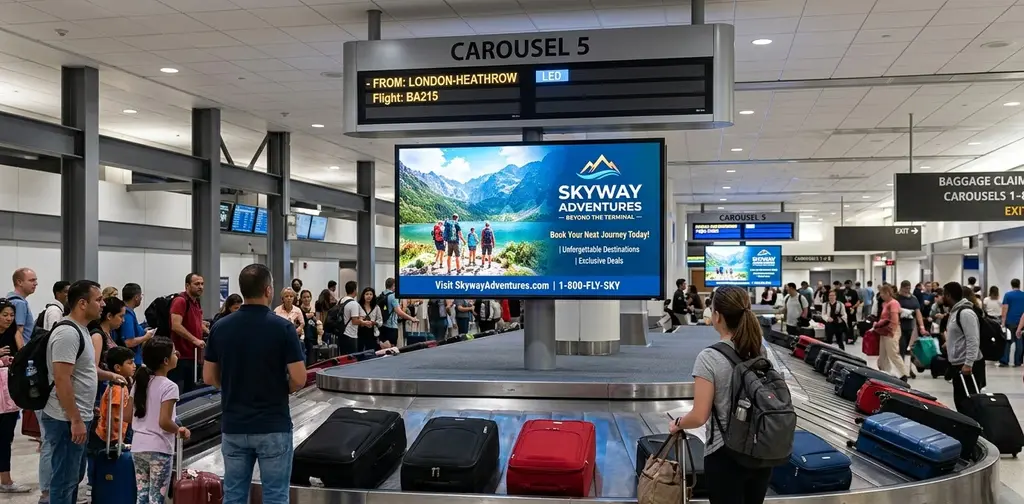
Brand awareness campaigns work because most of your future customers aren't ready to buy today, and the brands they remember when they finally are ready win the sale. Research from the Ehrenberg-Bass Institute (the "95-5 rule") shows that at any given moment up to 95% of buyers are not in the market; only about 5% are ready to purchase now.
Consistent exposure keeps your brand in the memory of that 95% so it surfaces first when their need arrives. Digital signage supports this by delivering repeated, high-recall exposure in the physical places where people already spend time.
Presence captures demand whenever it appears. Because only a small share of your audience is in-market at any time, you cannot predict the day someone becomes a buyer
What a Brand Awareness Campaign Actually Does?
A brand awareness campaign builds mental availability: the likelihood that your brand comes to mind in a buying situation. It prioritizes reach, consistency, and memorable exposure over immediate clicks. The payoff is delayed but compounding. You are planting recognition now so that you are the default choice later.
This is why marketers are often advised to weight budget toward long-term brand building (commonly cited as roughly 60% brand, 40% activation). Awareness is not a "nice to have"; it is the engine that makes activation cheaper and conversion easier.
Why The Mechanics Work
Repetition builds recognition. Memory is built through repeated, consistent exposure. When a brand appears the same way across multiple touchpoints, recognition forms, and recall strengthen. The goal is not one big impression but many consistent ones.
Familiarity lowers perceived risk. People prefer the familiar. A brand seen regularly in everyday environments feels more established and trustworthy, which reduces hesitation at the decision point.
Presence captures demand whenever it appears. Because only a small share of your audience is in-market at any time, you cannot predict the day someone becomes a buyer. Continuous visibility means you are already familiar with them when that moment comes.
Why Digital Signage Is Effective For Awareness
Out-of-home and digital signage are among the highest-recall ad formats available. Out-of-home advertising delivers ad recall in the range of 82-86%, far above the roughly 46-57% typical of online and social ads, and 73% of consumers view digital out-of-home ads favorably, compared with about 50% for TV and 48% for social (Out of Home Advertising Association of America).
Digital displays also draw more attention than static ones in the same environment.
High-visibility placement: screens sit where people naturally look (retail floors, gyms, restaurants, lobbies).
Consistent exposure: content runs on a loop, so the same audience sees it repeatedly across a visit or a week.
Dynamic delivery: motion and video lift attention and recall versus static print.
Location targeting: brands appear specifically where their audience already is.
What This Looks Like Across Industries
Retail
A clothing store loops new arrivals near the entrance and fitting rooms, building familiarity that brings shoppers back.
Fitness
A gym repeats personal-training displays, and class offers members pass daily, lifting sign-ups over time.
Hospitality
A hotel uses digital displays to highlight spa and dining options guests didn't know existed.
Food and Beverage
A quick-service restaurant rotates promotions on menu boards so customers recognize deals instantly.
How To Measure Awareness (so it isn't a black box)
Awareness is slower to measure than clicks, but it is measurable. Track branded search volume, direct traffic, aided and unaided recall via short surveys, and lift in foot traffic during and after campaigns. Watch these over weeks, not days, to see whether mental availability is growing.
Key Benefits of Brand Awareness Campaigns
Increased brand recognition: Audiences quickly identify your brand
Improved trust: Familiar brands feel more reliable
Higher engagement rates: People interact more with known brands
Stronger market positioning: Your brand becomes easier to remember
Best Practices for Effective Brand Awareness Campaigns
Keep colors, fonts, logo, and message consistent everywhere.
One clear message per campaign; resist the urge to say everything.
Prioritize high-traffic placements with real dwell time.
Run long enough to build frequency; awareness compounds with repetition.
Align timing with when your audience is actually present.
Common Mistakes to Avoid
Rebranding or changing the message too often, resetting recognition.
Overloading a single screen with too much information.
Inconsistent branding across platforms and locations.
Low-visibility placement with little dwell time.
Stopping campaigns before frequency has built.
How Beam Helps
Beam turns screens across real-world venues into a managed awareness channel. From one dashboard, you place consistent, branded content in the high-traffic locations where recall is strongest, schedule it to match when your audience is present, and keep it uniform across every screen and location, which is where consistency awareness depends.
Ready to build recognition where decisions happen? Start your free trial at usebeam.io and put your brand in front of customers, on repeat.
Sources
Ehrenberg-Bass Institute, "The 95:5 Rule: Why B2B growth starts long before the purchase." [https://marketingscience.info/news-and-insights/the-955-rule-why-b2b-growth-starts-long-before-the-purchase]
Solomon Partners, "OOH posts lowest CPMs and highest ad recall in 2025." [https://digitalsignagepulse.com/news/ooh-posts-lowest-cpms-and-highest-ad-recall-in-2025-compared-to-other-media/]
Vistar Media, "Facts about DOOH" (citing Out of Home Advertising Association of America data). [https://www.vistarmedia.com/blog/facts-about-dooh]
How long does a brand awareness campaign take to work?
Awareness compounds over weeks and months. Because only about 5% of buyers are in-market at once, the value shows up as more of that audience moves into buying mode already familiar with you.
Can small businesses run awareness campaigns?
Yes. A single screen in a high-traffic location delivers repeated local exposure at a fraction of broadcast costs.
What content works best?
Simple visuals, one clear message, and consistent branding elements that are easy to recognize at a glance.
Does awareness actually lead to sales?
It increases the odds your brand is chosen when the customer is ready, and it makes your direct-response advertising more efficient because the audience already recognizes you.