How Independent Pharmacies Use Digital Signage to Lift Front-End Basket and Earn From Waiting-Area Screens
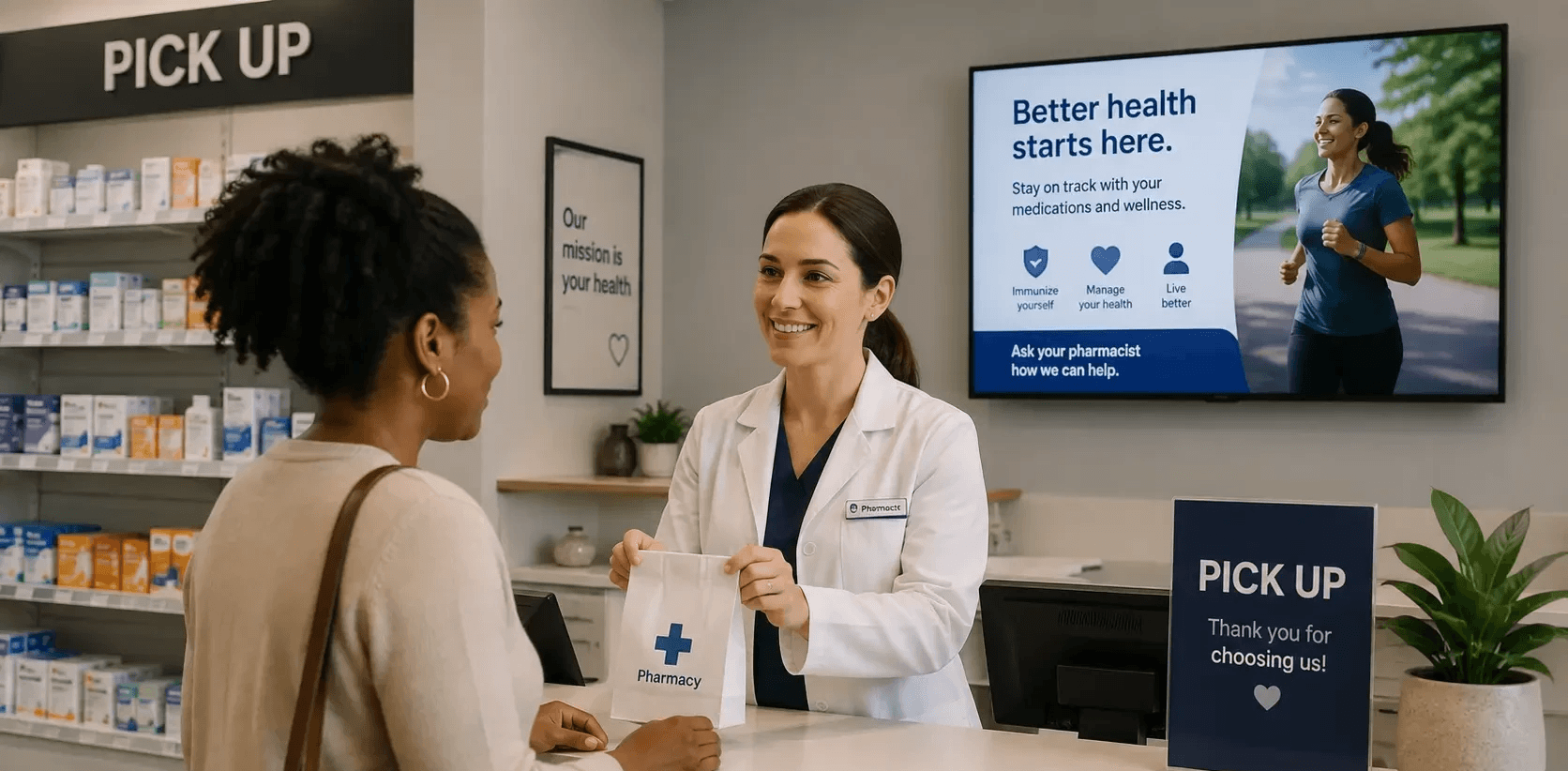
A screen at the pickup counter works because your customer is already standing still. Independent pharmacies pull roughly 96 percent of total sales from prescriptions, according to the NCPA Digest, which means the front-end shelves and clinical services sitting a few feet away are badly under-sold. A well-programmed screen during a 15 to 30-minute wait is the cheapest way to fix that, and with Beam, the same screen can also pay you back by running approved third-party ads in the gaps.
The KPI is front-end basket and service uptake, not "engagement"
Independent pharmacy is a $103 billion market, but the margin story has moved. Reimbursement pressure means the growth levers are the ones you control: front-end attachment, immunization volume, medication synchronization enrollment, adherence packaging, point-of-care testing, and durable medical equipment. Those are the numbers a screen can move.
Track three things before and after you install:
Front-end items per prescription pickup
Immunizations administered per week
Enrollments in med sync, adherence packaging, or a wellness program
The customer waiting for a refill is the most captive audience in retail, and most pharmacies show them a wall
What the wait actually gives you
Research on outpatient pharmacy waiting times found average waits well past 30 minutes in many settings, and community pharmacy waits commonly run 15 to 30 minutes for a routine fill. That is a long, undirected stretch of attention. A poster does not change during it. A screen does.
Pharmacist-delivered immunization programs are associated with meaningful uptake gains, with published estimates ranging from about 2.2 percent to more than 18 percent depending on the intervention and setting. Signage will not deliver the high end of that range on its own. What it does well is make the offer visible at the moment a patient could act on it, so your staff has fewer cold openings and more warm ones.
A programming loop that earns its screen time
Run a short rotation, 20 to 30 seconds per slide, and keep it honest.
Vaccines available today, with the walk-in policy stated plainly
Med sync and adherence packaging, framed as fewer trips
Two front-end items with a real reason to buy now, seasonal or condition-linked
Point-of-care testing, hours, and what insurance typically covers
Your own services patients do not know about, such as compounding, delivery, or DME fitting
Keep clinical claims conservative and consistent with your state board rules and any manufacturer requirements. Do not put patient names or queue positions on a public screen. HIPAA exposure is easy to avoid here, and worth avoiding deliberately.
Rule of thumb: if a slide does not name a service, a price, or a next step, cut it. Decorative slides train customers to stop looking
Where the second revenue stream comes from
Most pharmacies do not have enough of their own content to fill a full day of screen time, so the rotation gets repetitive and people tune out. Beam solves that by opening your unsold slots to the Beam Network, a pool of approved third-party advertisers who pay to reach the people standing in your store.
Out-of-home advertising hit a record $9.46 billion in the US in 2025, and digital formats grew 10.5 percent year over year to reach 36.3 percent of total OOH revenue, per the OAAA. Advertisers want indoor, dwell-heavy inventory. A pharmacy waiting area is exactly that. You keep control of what runs, and the ad revenue offsets the cost of the hardware and the software.
Honest limits
Signage attribution is directional. You will see front-end basket and vaccine volume move, but you will not be able to isolate the screen from staffing, season, and local demand with any precision. Run a clean before-and-after over at least eight weeks, hold your other promotions steady, and treat the result as a signal rather than proof. Signage also does not change your Google rankings. It can prompt branded search and reviews, which are separate and slower effects.
How Beam helps
Beam runs on the TVs you already own. You get remote scheduling across one store or a dozen, dayparting so morning refill traffic sees different content than the after-work rush, and a content library you can update from a laptop. The differentiator is the network: unsold screen time is offered to vetted advertisers, you approve the categories that run, and idle inventory turns into monthly revenue instead of a static loop nobody watches.
Get started
Put one screen behind the pickup counter, program the five-slide loop above, and open your unsold slots to the network. See how it works at usebeam.io.
Sources
Do I need a commercial display or will a regular TV work?
A standard consumer TV works for most pharmacy waiting areas. Commercial panels matter when the screen faces direct sunlight or runs more than 16 hours a day.
Can I put patient information on the screen?
No. Keep names, prescription details, and queue positions off any public display. Use anonymous ticket numbers if you need a queue indicator.
Do I control which advertisers appear on my screens?
Yes. You can approve categories and block specific advertisers, including competing pharmacies and those that conflict with your clinical positioning.
How much content do I need to create myself?
Five to eight slides is enough to start. Refresh the seasonal and vaccine slides monthly and leave the service slides in place longer.
How long before I see a change in front-end sales?
Give it eight to twelve weeks. Attachment behavior shifts slowly, and shorter windows get swamped by seasonal prescription volume.
Does this work for a single-location pharmacy?
Yes. Single-site operations often see the clearest results because one person controls the content and can respond to what is selling that week.