How to Open a Restaurant: Costs, Steps, and What to Know Before You Launch
Opening a restaurant takes a concept, a business plan, funding, a location, licenses, a menu priced for profit, a trained team, and a launch plan, usually over 6 to 12 months. The opportunity is large. The U.S. restaurant industry is projected to reach 1.5 trillion dollars in sales in 2025 across more than 1 million locations, according to the National Restaurant Association.
This guide walks through the steps, the real costs, and the numbers to know before you sign a lease.
Define your concept and market
Start with a concept you can describe in one sentence. Pick a cuisine, a service style (full service, fast casual, quick service, or takeout), and a target customer. Study the local market: who eats nearby, what competitors charge, and what gap you can fill.
A tight concept guides every later decision, from location to menu to pricing.
Write a business plan and set a budget
Your business plan turns the concept into numbers. Include market research, the menu, staffing, marketing, and a financial model with startup costs, monthly overhead, and a break-even point. Budget carefully, because costs usually run higher than first-time owners expect.
Reality check on cost
Industry estimates put a moderately sized full-service restaurant near 375,000 dollars to open, with a typical range of 175,000 to 750,000 dollars or more. A small takeout spot can start around 75,000 to 150,000 dollars. Treat these as planning ranges, not quotes.
Startup cost by restaurant type
Restaurant type | Typical startup range |
Small takeout | 75,000 to 150,000 dollars |
Moderate full-service, | 175,000 to 750,000 or more |
Prime urban full-service | 1,000,000 dollars or more |
Secure funding
Most owners combine sources: personal savings, a bank or SBA loan, investors, or partners. Lenders want to see your business plan, your projections, and often 15 to 30 percent of the total as owner equity. Raise enough to cover build-out, equipment, licenses, and at least three to six months of operating costs before you break even.
Choose a location and sign a lease
Location drives foot traffic, rent, and permitting. Match the site to your concept, then check zoning, parking, and nearby demand.
Rent for a small to mid-sized restaurant commonly runs 2,000 to 12,000 dollars a month. Read the lease closely and negotiate a build-out allowance before you sign.
Register the business, licenses, and permits
Register your business entity, then apply early for the licenses your area requires. Common ones include a business license, a health or food service permit, a liquor license for alcohol, a sign permit, and food-handler certification.
Rules vary by city and state, so confirm the exact list with your local health department and licensing office. If you plan to grow to 20 or more locations, federal menu calorie-labeling rules apply.
A tight concept guides every later decision, from location to menu to pricing.
Design the space and buy or lease equipment
Plan the kitchen and dining flow before you build. Build-out commonly runs 50 to 300 dollars per square foot, and a mid-sized kitchen setup runs 50,000 to 150,000 dollars. Leasing equipment and choosing a smaller footprint are two ways to lower upfront cost.
Build a menu priced for margin
Design a menu you can execute consistently, then price it for profit. Margins are thin. Average net profit margins run about 3 to 5 percent for full-service restaurants and 6 to 9 percent for quick service. Cost every dish, track food and labor as a share of sales, and keep the menu focused so the kitchen stays fast.
Hire and train your team
Hire for the roles your concept needs: kitchen, front of house, and a manager. Train on food safety, service standards, and your point-of-sale system before you open. A soft opening lets the team rehearse with real guests at lower stakes.
Set up your tech and screens
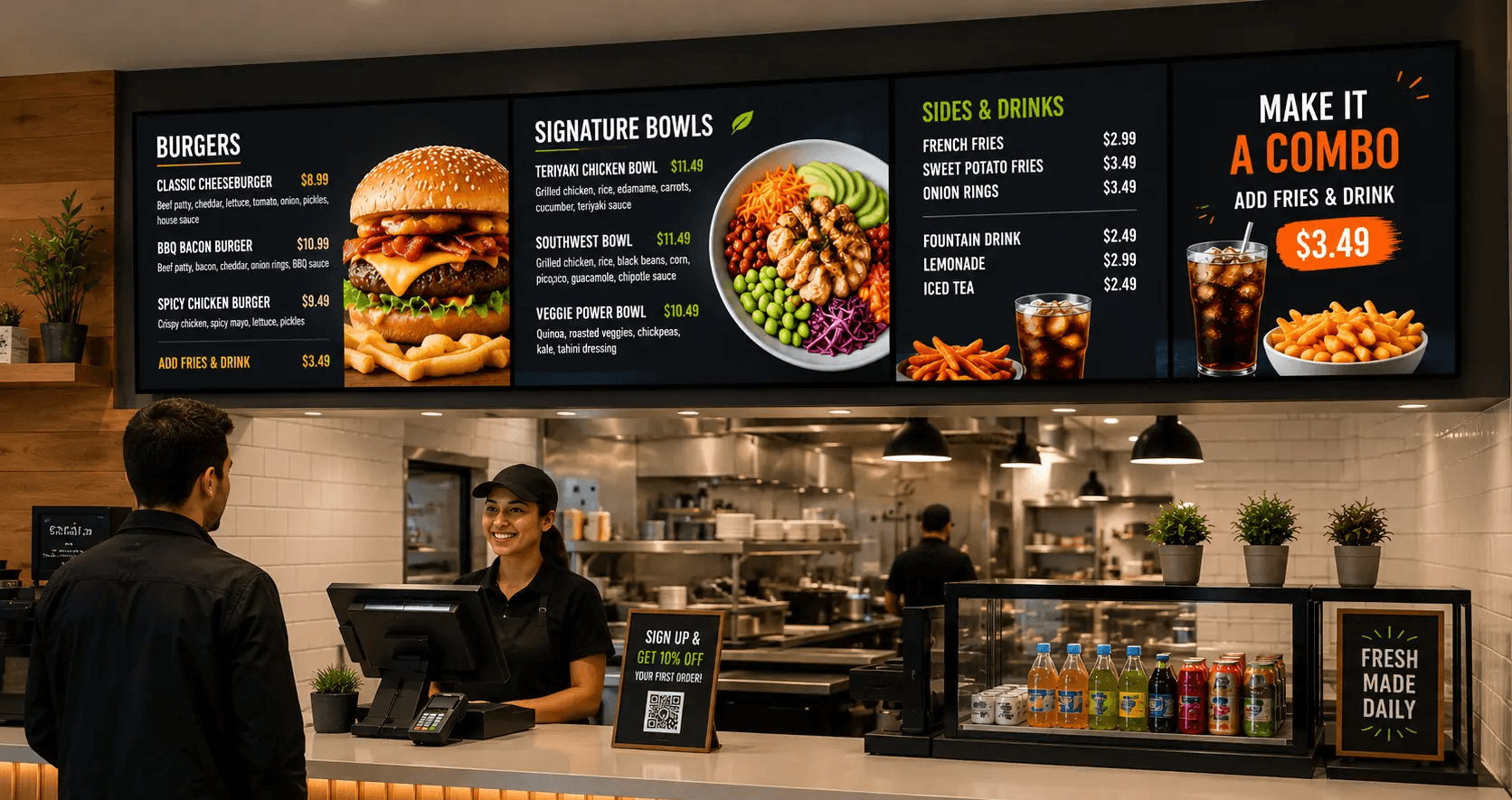
Choose a point-of-sale and payment system, then plan your in-store screens early. Digital menu boards keep pricing and specials current without reprinting, and promo screens near the counter lift add-ons. Screens also let you feature high-margin items right where guests decide what to order.
Plan your launch
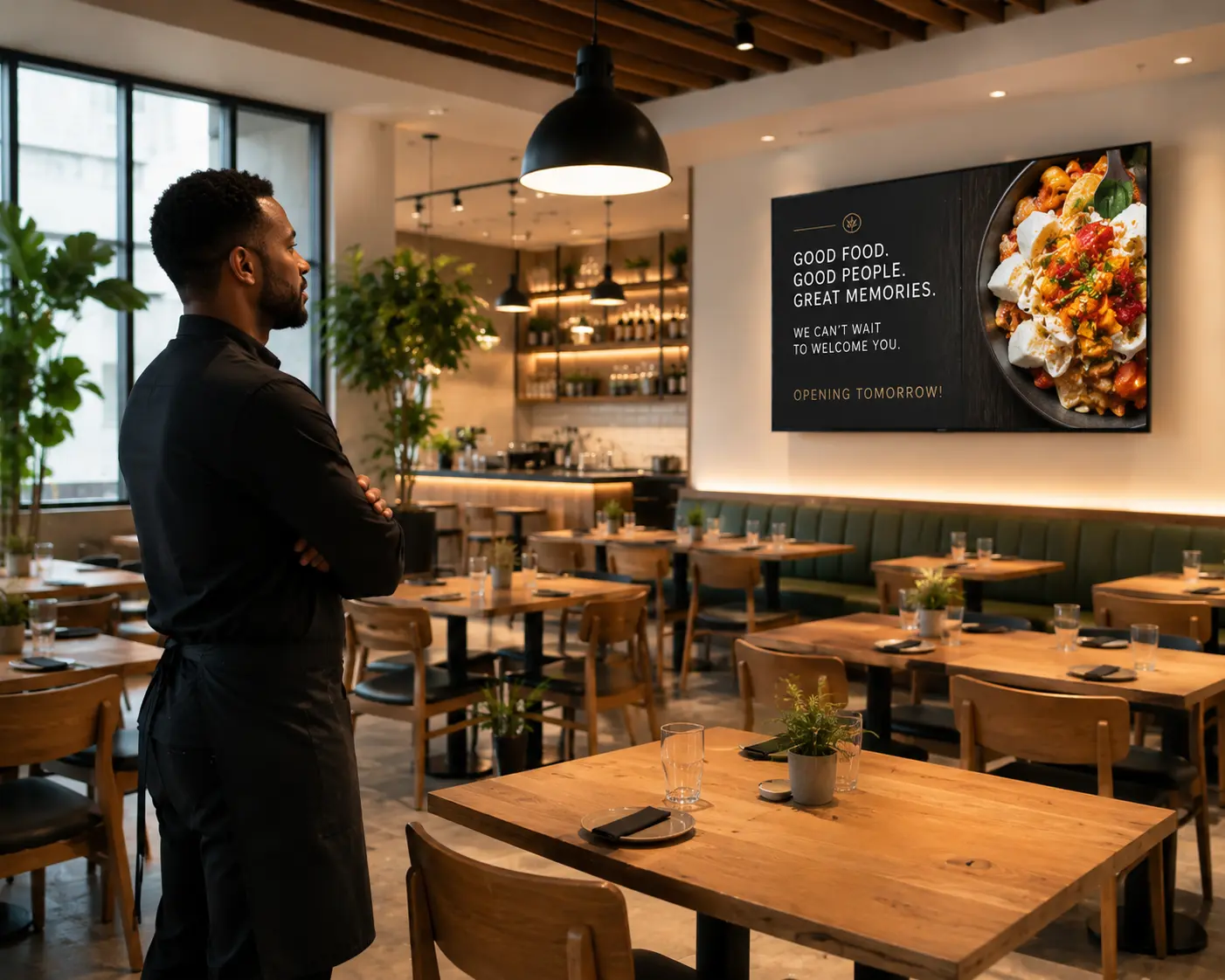
Build interest before day one. Set up your Google Business Profile, claim your local listings, post on neighborhood social channels, and invite the community to a soft opening. Early reviews and word of mouth carry weight, so make the first weeks count. Ask happy guests for honest feedback, and never pay for or incentivize reviews.
How Beam helps once you open
Once the doors are open, your screens do double duty. Beam turns your TVs into managed digital signage you control from one dashboard, so menu boards, specials, and upsell prompts update in minutes across every screen. The difference is what happens during idle time. Beam Network lets you open unused screen time to approved advertisers and earn passive income from screens you already run. You keep control, block competitors, and hold priority slots for your own content.
For a new restaurant working with a 3 to 5 percent margin, a menu board that lifts average order value and a screen that adds a small ancillary revenue line both help. Signage supports sales rather than guaranteeing them, and screen attribution is directional.
How Beam helps. One dashboard for menu boards, promotions, and paid network ads, with full control over what runs on your screens.
Open smarter with Beam
Plan your screens alongside your build-out. See how Beam runs menu boards and monetizes idle screen time at usebeam.io
Sources
How much does it cost to open a restaurant?
Industry estimates put a moderately sized full-service restaurant near 375,000 dollars, with a common range of 175,000 to 750,000 dollars or more. A small takeout concept can start around 75,000 to 150,000 dollars, depending on location, equipment, and build-out.
How long does it take to open a restaurant?
Most independent restaurants take about 6 to 12 months from concept to opening. Permitting, build-out, and hiring are the usual bottlenecks, so start licensing early.
What licenses do I need to open a restaurant?
Requirements vary by location, and common ones include a business license, a health or food service permit, a liquor license for alcohol, a sign permit, and food-handler certification. Confirm the exact list with your local health department and licensing office.
Do most new restaurants fail in the first year?
No. The 90 percent claim is a myth. Research from H.G. Parsa and colleagues found about 26 percent of independent restaurants close in year one and roughly 60 percent within three years, so the risk is real but far lower than the myth.
What profit margin can a restaurant expect?
Average net margins run about 3 to 5 percent for full-service restaurants and 6 to 9 percent for quick service. Tight food and labor costs are the main reason margins stay thin.
Do I need digital signage to open a restaurant?
No, but screens earn their place quickly. Digital menu boards keep pricing current, promo screens lift add-ons, and platforms like Beam let you offset costs by earning from idle screen time.